


Livre | 24h/24_PARADISE - Hommage à Philippe Franck | Société i Matériel - NoCode Éditions
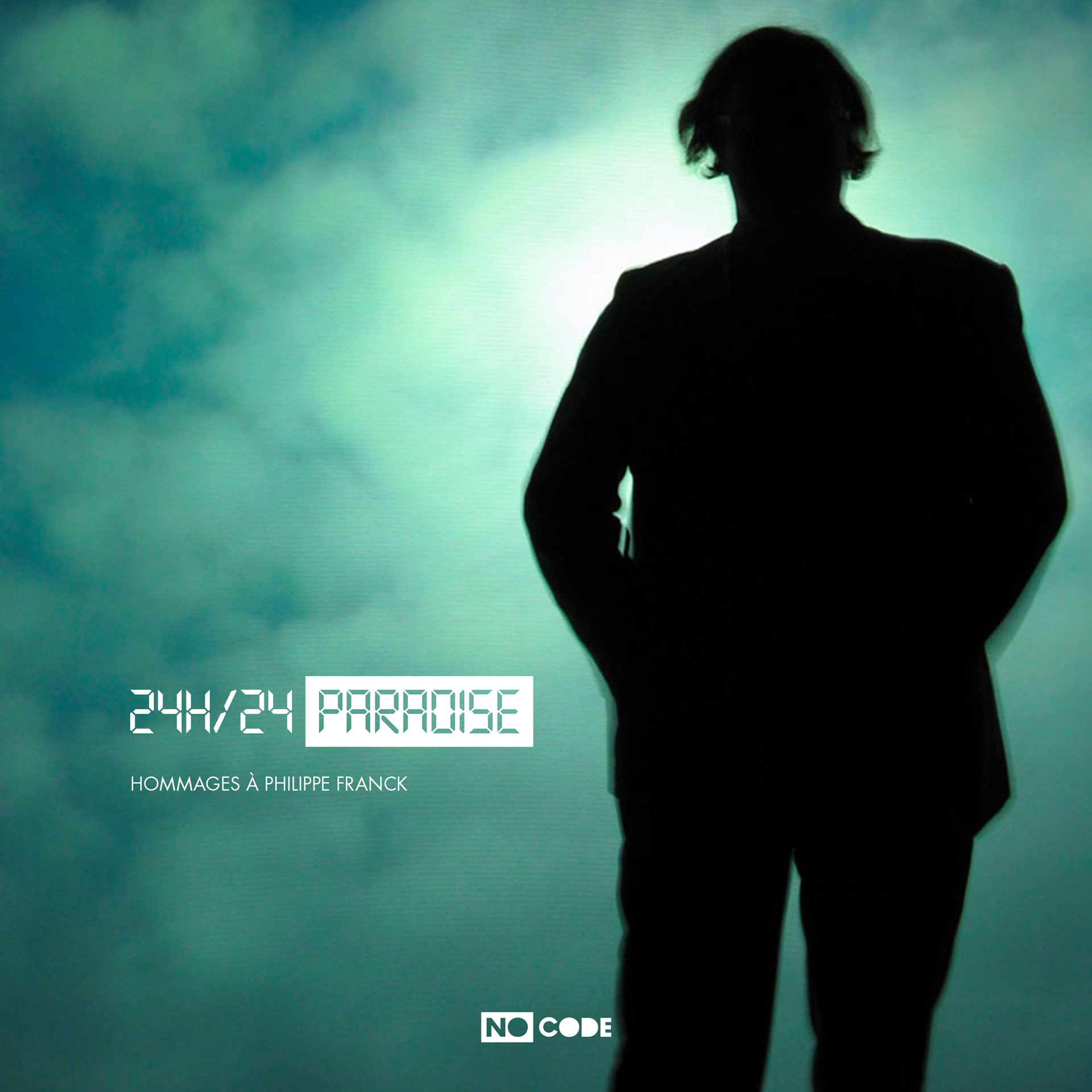
Présentation
24h/24_PARADISE is a bilingual French/English collective volume, at the crossroads of sound and digital arts, research-creation, and a poetico-political tribute. Bringing together artists, theorists, performers and friends of Philippe Franck, a central figure in sound arts and founder of Transcultures, the book orchestrates a polyphony of texts, narratives and essays. Built around the eponymous work— a connected hybrid event between Mons and Seoul— it becomes at once an archive, a manifesto, a laboratory for experimentation and a ritual of memory. Each contribution, whether theoretical, biographical, fictional or performative, extends an aesthetic of the fragment, of flow and of the interstice, sketching a discontinuous territory of affects, networks, sounds and thoughts.
Contributors (provisional list)
Alexander Macsween, Alexandre Castant, Anne-Laure Chamboissier, Biba Sheikh, Béatrice de Fays (B2FAYS), Carole Brandon, Christian Leroy, Christian Vialard, Christophe Denis, Daniel Van Acker (aka Daniel Duchamp), Daniel Vander Gucht, Didié Nietzsche, Dominique Vermeesch (DO.SPACE), Emmanuelle Vincent, Frédéric de Lapaillonne, Gabriel V. Soucheyre, Gaëtan Le Coarer, Gilles Malatray, Isa*Belle Vrammout, Jacques Urbanska, Jean-François Octave, JJ Duerinckx (alias Maurice Charles JJ), Jordan Fraser Emery, Khaldoun Zreik, Maja Jantar, Marc Veyrat, Marie Julie, MI+LOUS, Natalia de Mello, Natan Karczmar, Panayiotis (Takis) Kyriakoulakos, Petermfriess, Philippe Baudelot, Philippe Boisnard, Pierre Larauza, Planned Accidents, Rafaël Sanchez, Robin Rimbaud (Scanner), Rudy Rigoudy, Régis Cotentin, Stéphane Kozik, Yves Tassin, Zoé Suliko…
24h-24 PARADISE (19 avril 2025)
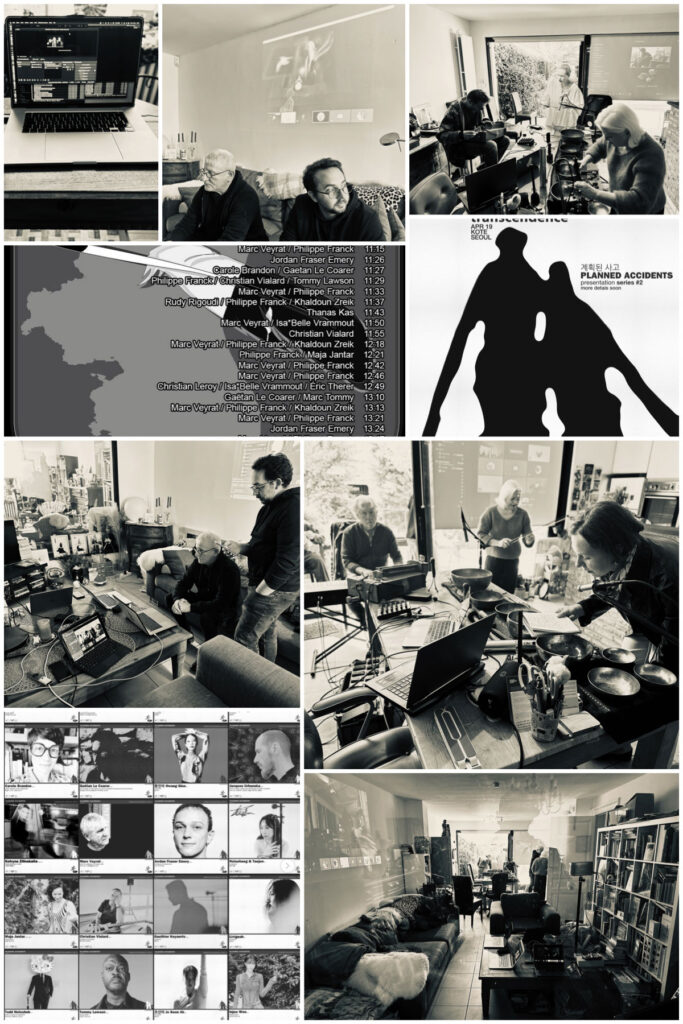 Initiated by Marc Veyrat, Gaëtan Le Coarer, Isa*Belle Vrammout and Société i Matériel, 24h-24 PARADISE was a hybrid artistic and commemorative event that took place in April 2025, simultaneously in Mons (Belgium) and Seoul (South Korea – as part of Planned Accidents #2). It pays tribute to Philippe Franck, sound artist, curator and director of the Transcultures association, who passed away shortly beforehand. The event brought together a group of artists, researchers, performers and friends of Philippe Franck in a dynamic of collective networked creation.
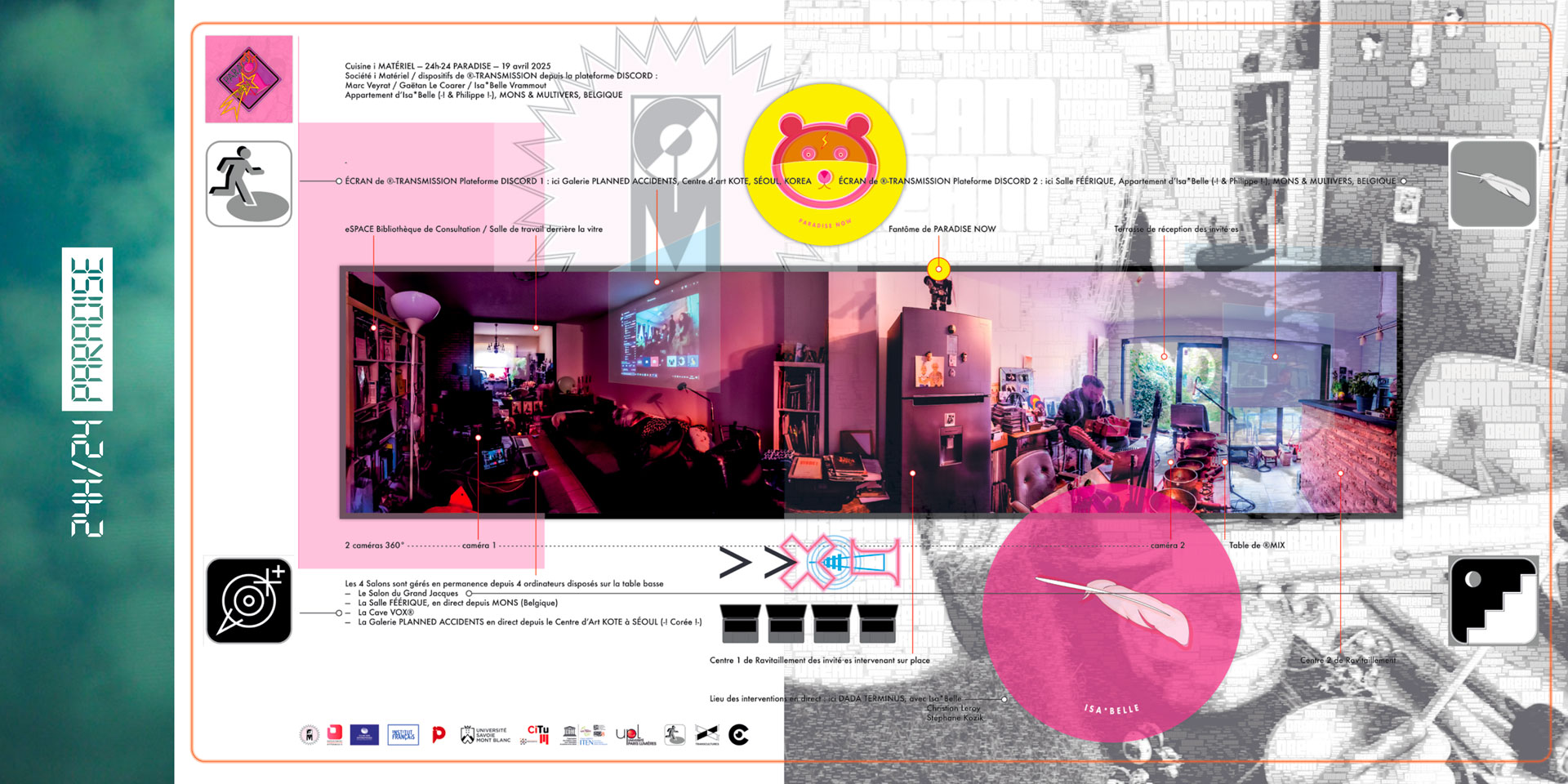
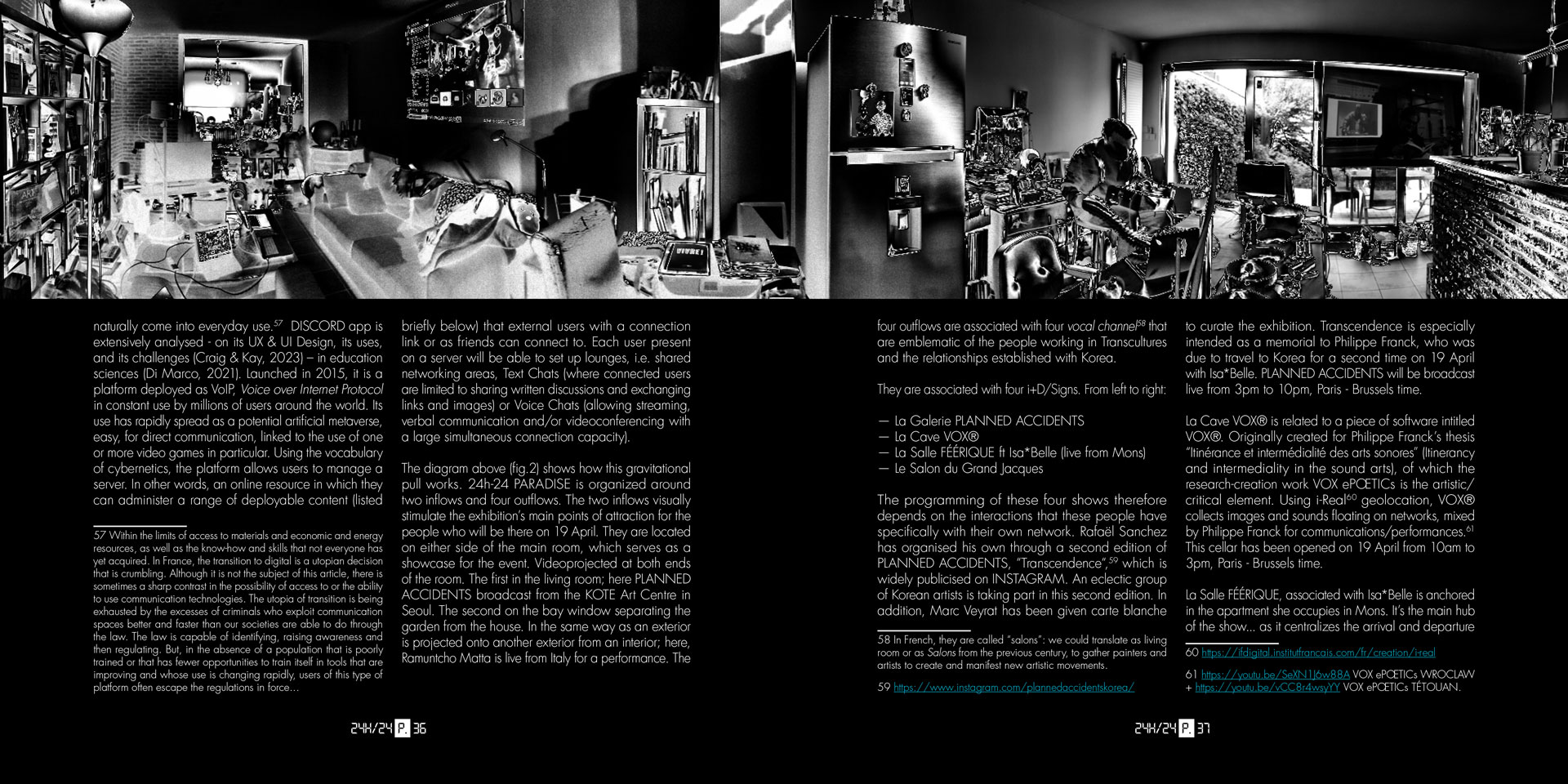
Conceived as a work in itself, 24h-24 PARADISE is based on the use of the Discord platform, chosen for its flexibility of use and its server and channel functionalities, audio, video and text exchanges. Four main channels structured the event:
- FÉÉRIQUE Room (centred in Mons, Philippe Franck’s place of residence, coordinated by Isa*Belle Vrammout),
- Grand Jacques Channel (associated with Jacques Urbanska, deployed on Second Life, YouTube and the Transcultures website),
- VOX® Cellar (linked to Philippe Franck’s VOX ePŒTICs research-creation project),
- PLANNED ACCIDENTS Gallery (from Seoul, under the direction of Rafaël Sanchez).
These channels hosted performances, broadcasts, artistic interventions and discussions throughout 24 continuous hours. In parallel, several video streams (incoming and outgoing) were projected in the physical space in Mons, creating an immersive set-up that was both local and connected.
The event is part of a research-creation approach, an exploration of digital dispositifs and intermedial experimentation, intersecting issues of remote presence, memory, collective performativity and artistic ritual. It thus articulates the intimate and the public spheres, the local and the global, in a context of post-lockdown and increased circulation of online artistic practices.
Catalogue 24h-24 PARADISE
Over the course of its some 300 pages, 24h-24 PARADISE composes a discontinuous cartography in which critical writing, speculative fiction, sound poetry, intimate memories and conceptual scores intertwine, all traversed—directly or in hollow—by the figure of Philippe Franck. The book does not merely document an event: it extends its logics of activation, by disseminating forms, shattering formats, multiplying regimes of discourse. One encounters reflective contributions on post-digital aesthetics, narrative détournements, handwritten tributes, transcriptions of performances, creation protocols, theoretical fragments that elude disciplinary frameworks.
The volume acknowledges the heterogeneity of its voices (artists, researchers, fellow travellers, close ones, distant presences) without ever seeking to neutralise it. This diversity is not only aesthetic; it reverberates the multiple affinities, dialogues and transmissions that, over the years, have orbited around Philippe Franck—at once a catalyst of practices, an attentive mediator and an instigator of spaces for shared creation. This polyphony produces an effect of controlled saturation, where tonalities overlap more than they follow one another. Analytical texts on sound geopolitics or technological ubiquity sit alongside sensory narratives, hallucinatory visions, field notes, autofictions traversed by an absent figure, by diffraction. In places, the voice doubles, slides, becomes code, noise, quotation. Elsewhere, it returns in the form of notation, of silence, of mantra.
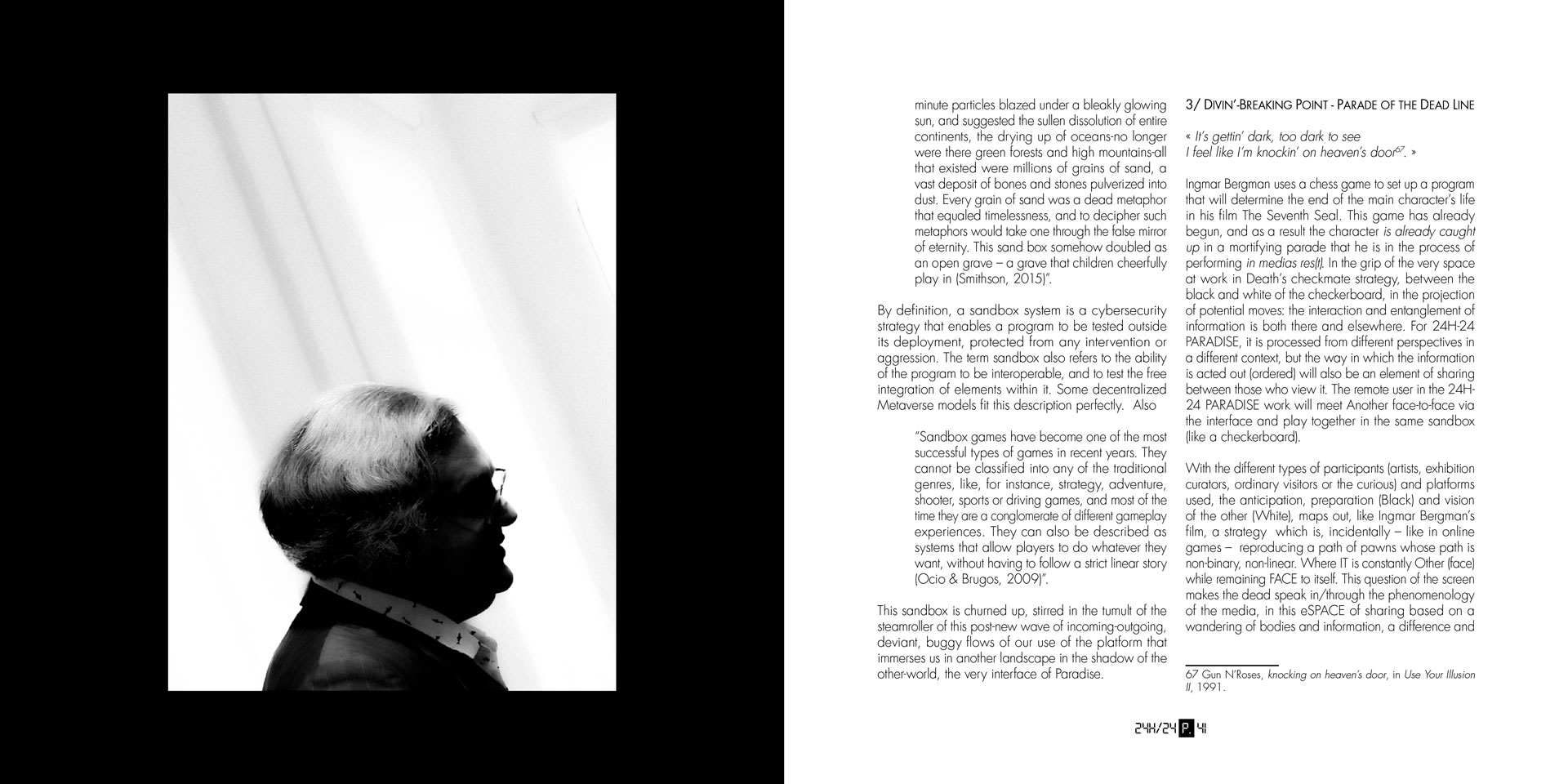
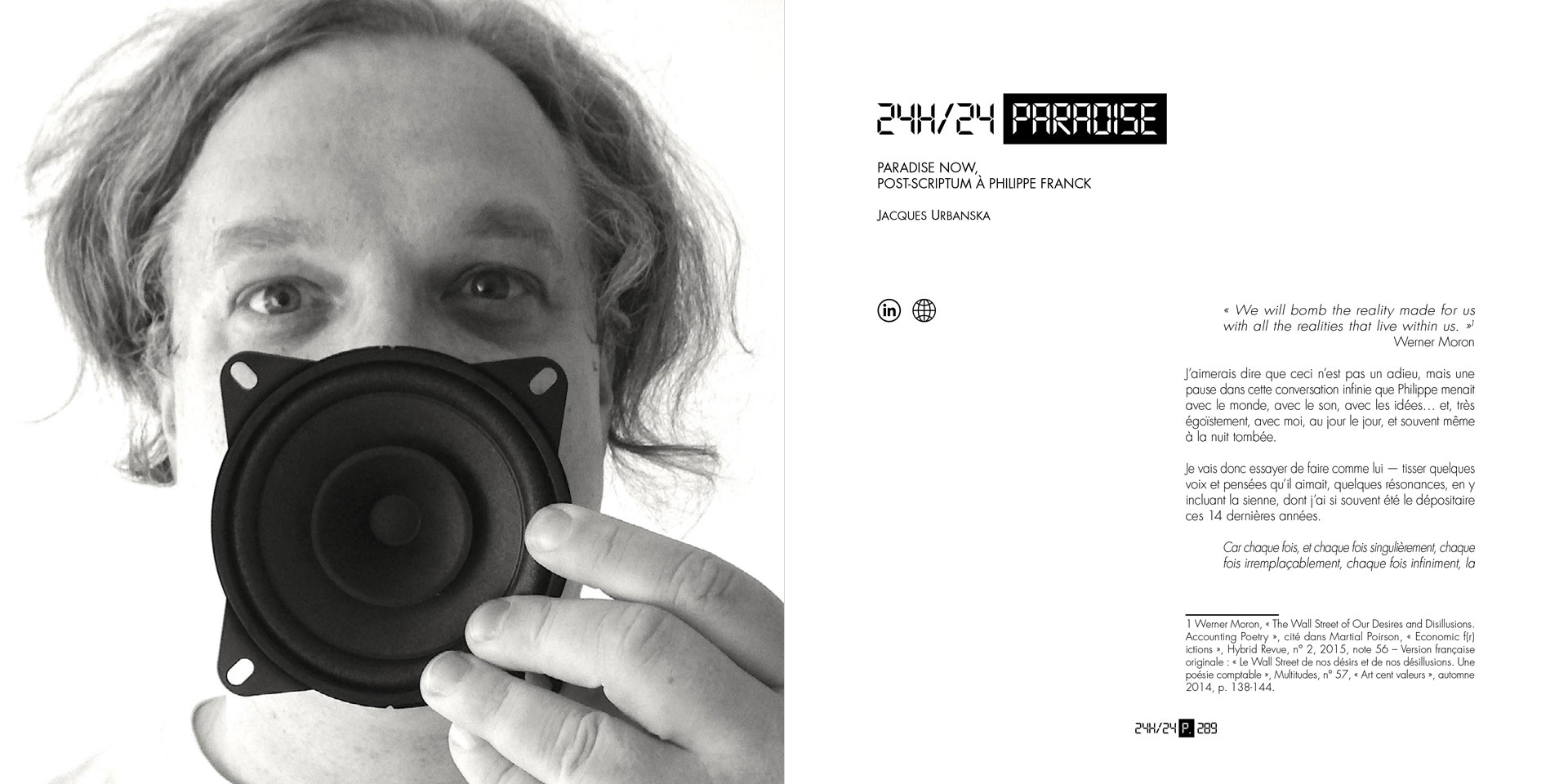
The book’s architecture is non-linear. You can enter at any page, drift from an interview excerpt to a drawing, from an encrypted image to a sequence of words addressed to no one. Thematic clusters emerge, without ever fixing interpretation: affective inter-worldliness, glitch strategies, embodied archives, speculative geographies, connected bodies, cybernetic rites of passage. It thus produces its own conditions of reading, at once fragmentary and cumulative, immersive and dislocated. It posits no centrality, except that of an absent presence around which texts, gestures, sounds and silences gravitate. More than a tribute, 24h-24 PARADISE acts as a network of persistences: each contribution plays the role of an emission point, a relay, a transformer. Nothing is closed; everything remains to circulate.
Some texts function as sensitive reconfigurations of the real: they shift the usual coordinates of critical writing to produce oblique forms of address, modulated by experience, mourning, memory or perceptual instability. One finds voices that perform their own erasure, diffracted narrations, autobiographical asides that fork into theoretical meditations. These are less finished objects than processes held in tension, open to incompletion.
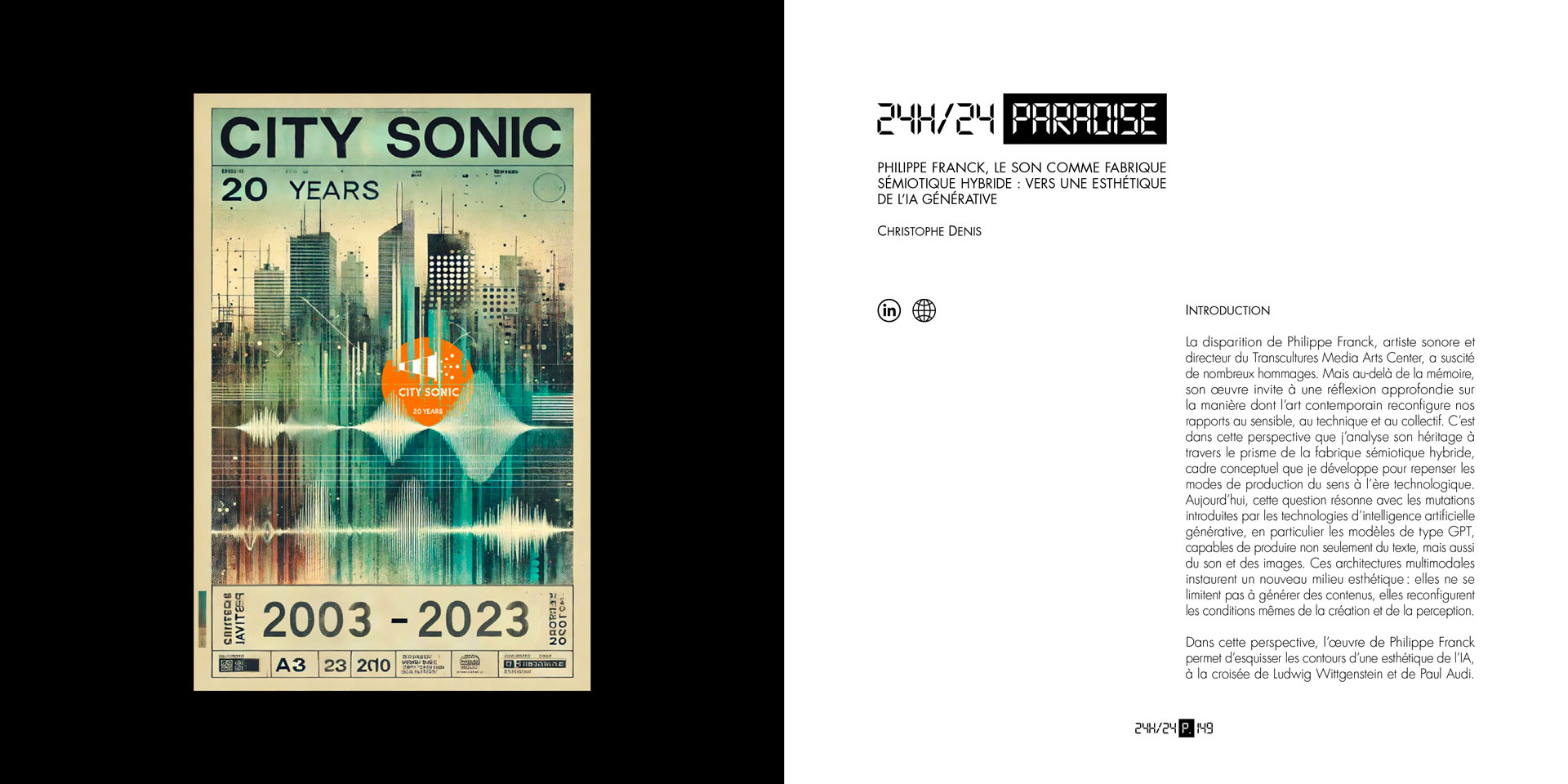
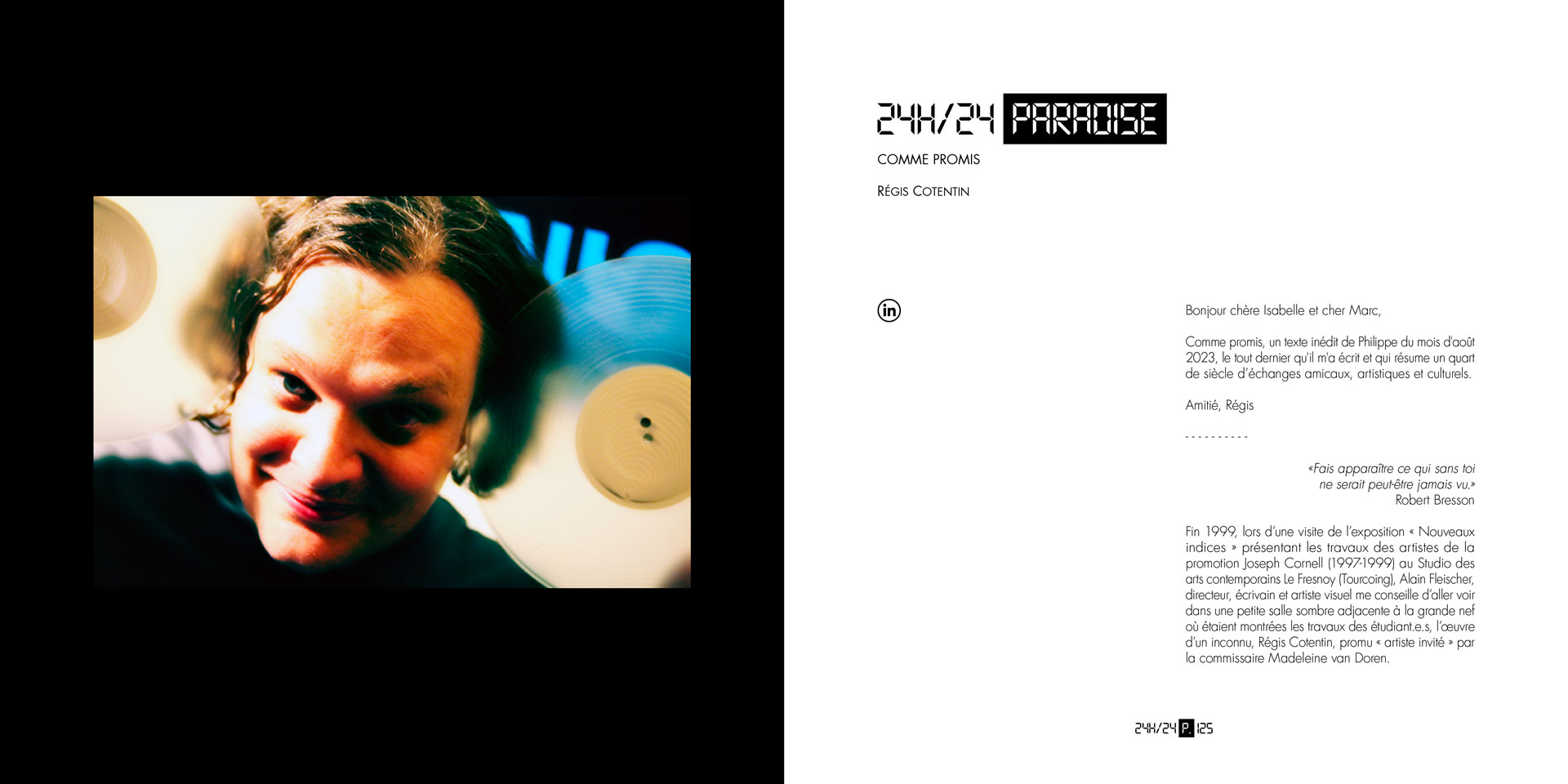
Several contributions use the book as an interface to replay, in deferred mode, what was transmitted online: gestures, sounds, dislocated presences. This transfer from one medium to another does not operate through simple transcription but through aesthetic translation: what was flow becomes rhythm, what was interaction becomes editing, what was bug becomes syntax. We witness a material reinvention of the ephemeral.
Finally, the catalogue accommodates within itself zones of low intensity: typographic silences, drawings, blanks, scans, interruptions. These spaces do not fill a void; they work on it. They extend the project’s fragmentary ethic, refusing completeness in favour of a circulation of forms, where each text becomes the cast shadow of another, in a logic of relay rather than sequence.
The authors did not limit themselves to a memorial function; they unfolded a book-network, a porous, affected, unstable volume, which acknowledges disappearance while moving through it. What plays out here is not so much the preservation of a legacy as its continuous activation, in a movement of relay, infusion and reinvention, around a founding absence.
For Transcultures Jacques Urbanska
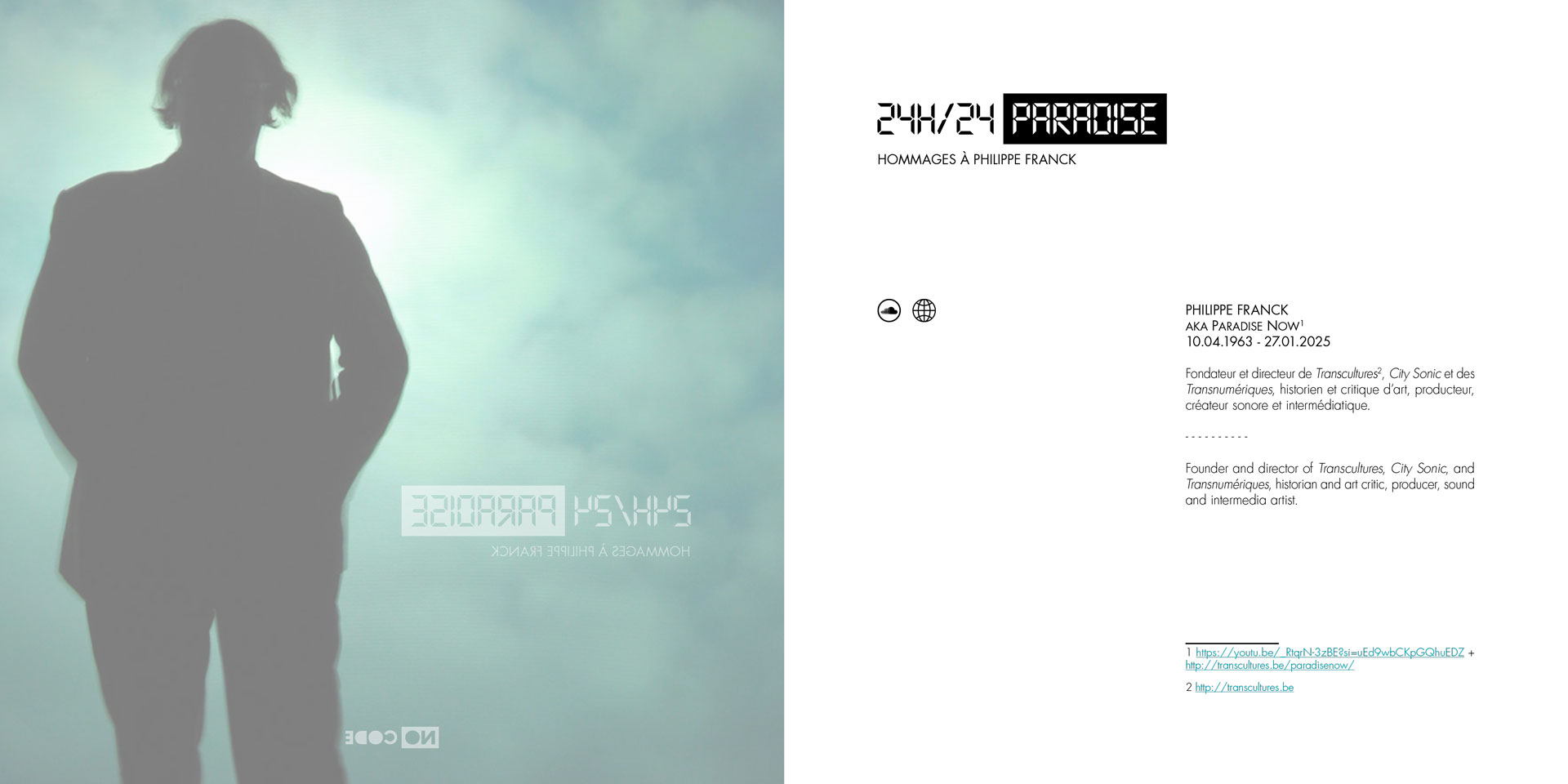
Philippe Franck

Under the name Paradise Now, Philippe Franck developed, from the early 1990s onward, a multifaceted artistic trajectory shaped by a forward-looking approach and a strong collaborative ethos. He composed and produced music for choreographic works, exhibitions, interdisciplinary performances and videos (notably for Régis Cotentin, Hanzel & Gretzel and Thomas Israël), as well as multimedia pieces in collaboration with digital artists Philippe Boisnard, Marc Veyrat and art2.network.
In 2014, Philippe Franck co-directed the film Bernard Heidsieck, la poésie en action, which was also released as a book-and-DVD box set titled Variations sur Bernard Heidsieck.
Alongside his collaborations with holistic performer Isa*Belle (several body/sound installations and performances since 2005), Paradise Now also worked with electronic musicians Christophe Bailleau (as part of the duo Pastoral), Gauthier Keyaerts (within Supernova), Stephan Dunkelman, Christian Leroy, Didié Nietzsche, and vocalist/performer Maja Jantar, as well as with several poets including Ira Cohen, Gerard Malanga, Werner Moron, Eric Therer, Catrine Godin and Habiba Sheikh. From 2021, he was part of the hypermedia collective Société i Matériel, where he was responsible for the sound and poetic dimension.
His recordings were released on labels including Transonic, Optical Sound and Sub Rosa. Philippe Franck passed away on January 27, 2025.
Une initiative de ...
Rudy Rigoudy | NoCode Éditions (Fr)
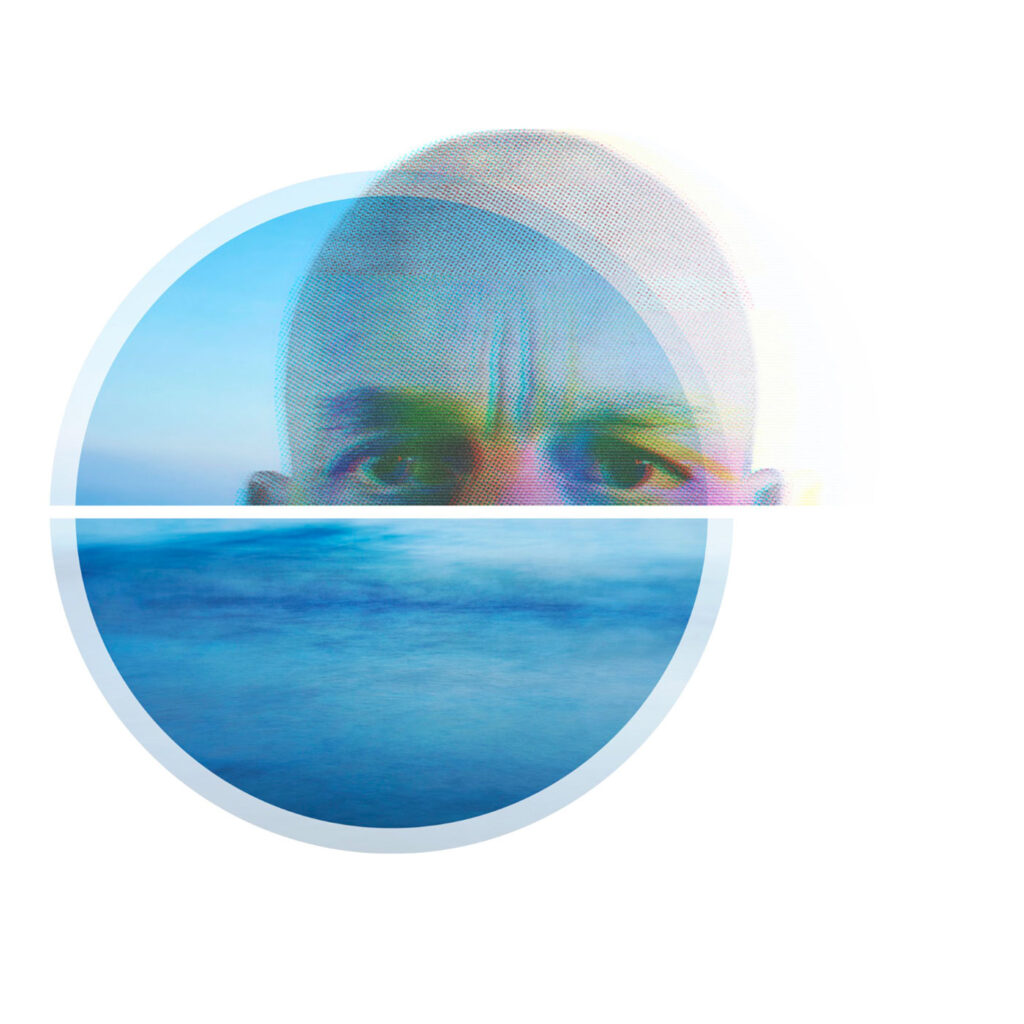 Rudy Rigoudy is an artist, educator, and designer whose practice is shaped at the intersection of image-making, technologies, and publishing. His work brings together an often hypermedia-based visual inquiry, a project-led pedagogy grounded in research-creation, and a demanding attention to the formatting of information. This triple stance is not an accumulation of roles: it forms a single field of experimentation, where producing an image, transmitting it, and editorializing it all belong to one and the same gesture.
His artistic research focuses on how the apparatuses of vision affect the perception of landscape. He examines the way devices—technical setups, interfaces, viewing protocols—determine what appears, what is concealed, what endures. Photographic images are conceived here as fluid objects, subject to shifts, recompositions, and recontextualizations. Staging them within hypermedia devices thus becomes a critical space: not only a mode of presentation, but a condition of visibility. His interest in chains of transformation (rules, combinatorics, indexing, layout operations) takes shape in processes where the device of production and the device of reading directly contribute to the final form, as evidenced in particular by the approach he outlines around the book *HyperUrbain 6* (ed. Marc Veyrat, Patrizia Laudati, Khaldoun Zreik), where constraints determine visual configurations that are then reinvested in the editorial work.
In parallel, Rudy Rigoudy pursues a teaching practice grounded in research-creation and a project-based pedagogy open to contemporary issues. Drawing on technical and technological know-how, a current culture of images, and analytical work on theoretical and cultural references, he supports students in developing skills connected to the professions of communication design. He works in particular within the field of Métiers du Multimédia et de l’Internet (MMI), where visual creation, the digital ecosystem, and publishing logics converge.
His work as a designer extends these concerns. Fascinated by the text–image relationship and maker practices, he treats form as an operator of meaning: structuring, hierarchizing, making legible, enabling circulation. The back-and-forth between paper and screen, between the visual and the conceptual, between art and communication, shapes an aesthetics of editorialization in which the image is never alone, but always caught within a regime of reading.
This logic finds a natural continuation in No code éditions, an editing and digital creation studio dedicated to the design, production, dissemination, and transmission of digital works. Conceived as a platform for fabricating hybrid objects, No code éditions develops forms in which the book enters into dialogue with multimedia extensions: paratexts, networked access, multiple entry dispositifs. The publication *24H/24 Paradise – Hommages à Philippe Franck*, stemming from an international event and from the transformation of the “catalogue” into a “hybrid monument,” illustrates this orientation: making publishing a space of assembly, memory, and activation, where paper and digital compose a single experience.
A practitioner of the image beyond the image, Rudy Rigoudy works on the very conditions of visibility: what makes things appear, what organizes the gaze, what turns an image into a situation. Between artistic dispositifs, transmission, and micro-publishing, he develops an approach in which art is made as much in forms as in protocols, and where publishing becomes a critical act in its own right.
Société i Matériel
 La Société i Matériel is a hypermedia project/collective initiated by Marc Veyrat, active since August 2000. Described as a collaborative structure “with variable geometry,” it is built on a central principle: using information as artistic material—whether in the form of text, image, sound, dispositifs, or networks.
The website imateriel.org functions as a portfolio-project, organized around “lines” and projects marking the collective’s history, with a recurring graphic vocabulary (i- prefixes, typographic play). Among the major strands is i-REAL, presented as a “board-and-VR GA-ME” playable against an AI, in virtual reality, explicitly connected to social platforms (Facebook/Instagram) and also envisioned in a “low-tech” version. U-rss is framed as a “Digital Art / hypermedia network” project built around a reflection on the “social portrait,” initially associated with Facebook and Google Earth, with a cited collaboration (Franck Soudan). SUGOROKU, an “Urban Game” conceived for the Biennale Internationale Design Saint-Étienne 2008, explores logics of routes and interactions via mobile phone and QR Code (collaboration mentioned: Catherine Beaugrand). ©box takes the form of a “virtual gallery / installation”: a portable, transportable interactive capsule presenting a selection of works (collaboration mentioned: Carole Brandon).
Within a research-creation logic, several entries link Marc Veyrat’s work to the study of the complexity of informational formatting and of information strategies as materials, notably through XR dispositifs and across social networks and the web.
The group, multidisciplinary and multimedial, has variable geometry. One can find a whole series of artists and researchers involved. La Société i Matériel notably brings together Franck Soudan (U-rss), Catherine Beaugrand (SUGOROKU) and Carole Brandon (©box, in partnership with CACL Lacoux), as well as Gaëtan Le Coarer, Jonathan Juste (programming), Philippe Franck (Paradise Now—its sonic and poetic dimension), Rudy Rigoudy (image/graphics/editions)…
Marc Veyrat is an artist, *Agrégé*, and *Maître de Conférences* HDR in Art Studies; Director of the Hypermédia Communication Department — Université Savoie Mont-Blanc, and researcher at the CiTu Paragraphe Laboratory — Université Paris 8; Associate Researcher, UNESCO Chair / ITEN (Innovation, Transmission, Digital Publishing).
Informations
- Release date: late January 2026
- The catalogue is available free of charge (ebook/PDF version)
- A printable version is available on command
- Editorial team : Isa*Belle Vrammout, Marc Veyrat, Gaëtan Le Coarer & Rudy Rigoudy
- Art direction: Marc Veyrat & Rudy Rigoudy
Production
- Société i Matériel – Edited by: No Code – Le Puy-en-Velay, France
- With the support of Transcultures/Transonic
