


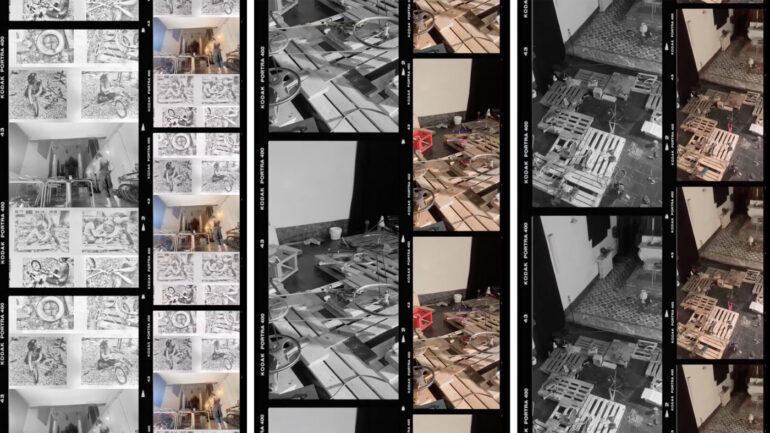
Following two initial residency periods in 2025, the Maladita collective returns this autumn for a post-production residency dedicated to their project Prince Charming.
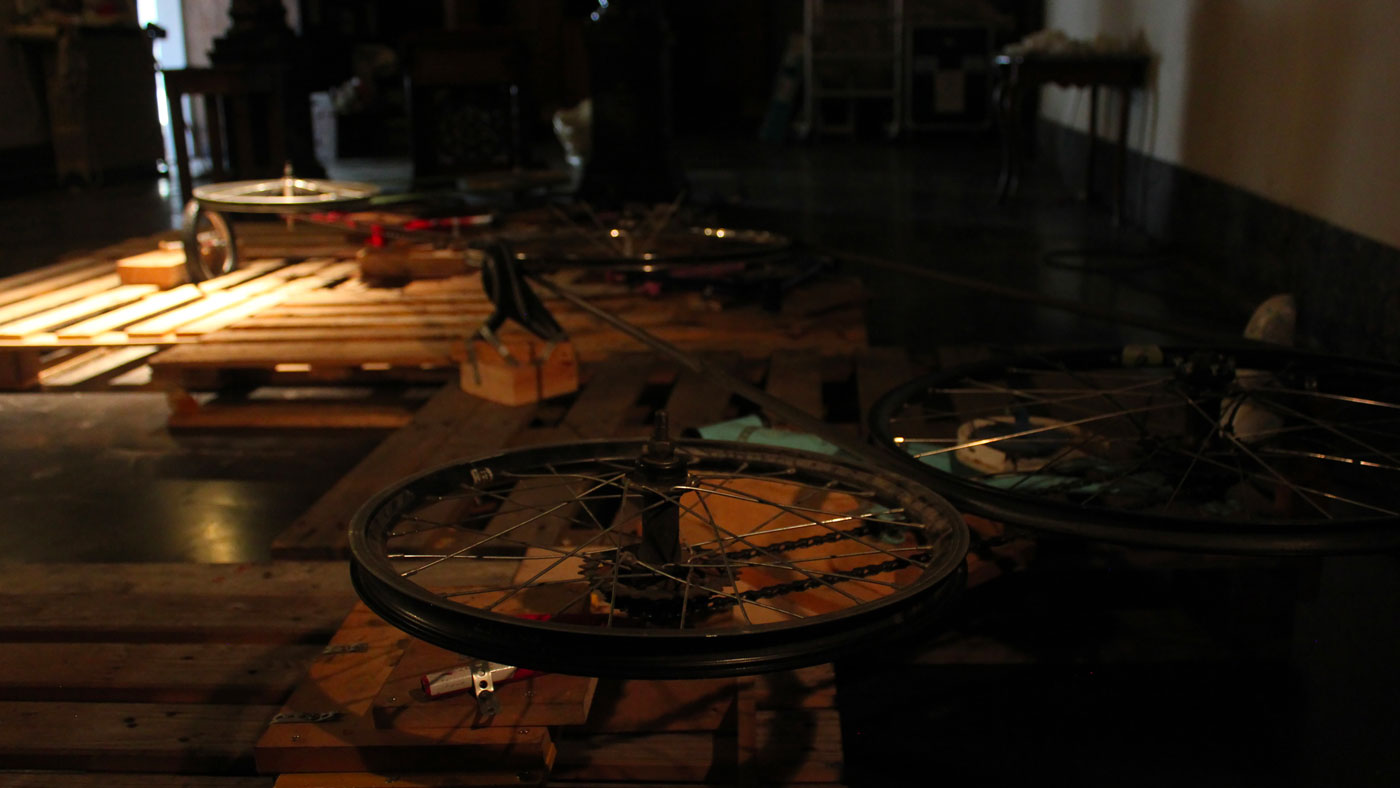
After designing and animating seven sculptures, and producing the structure intended to support them and give them a circular movement (rotating around their central axis) using reclaimed materials, including washing machine motors, bicycle wheels and chains, axles, belts and wooden pallets, the Quilteuses de Dour (Marie-Thérèse Faidherbe’s workshop) and a team of seamstresses from Hautrage created the costumes using fabrics found at the convent: curtains, sheets, stoles, doilies and velvet.
A prototype vending machine for merchandise, Le Lupanar, was also created using printer motors, wooden boards and belts salvaged from the convent. Part of this second stay will also be devoted to it, creating the objects available beneath pink neon lights: candles, key rings, bottles, condoms, caps, T-shirts, soaps, relics and trinkets bearing the likenesses of the female saints.
The second residency period was devoted to refining the installation and its scenography, while this third working period will focus on the project’s post-production.
This installation draws inspiration from the altars and merchandising observed in cities such as Naples, where religious devotion is deeply embedded in the urban landscape, and offers a contemporary reinterpretation of devotional practices.
A publishing project will also emerge from traces found at the convent: letters, testimonies, fragments of images and the voices of the sisters. These fragments of history will be interwoven with an account of the collective’s residency work and reflections, alongside parallels with the stories of the martyrdom of the female saints.


Prince charming
The saints are made of papier-mâché at life size. There are seven of them, set in motion by a motorized mechanism and presented in a cardboard theatre with baroque or neoclassical overtones. The scene is completed by syncopated fluorescent pink neon lighting, a mirror ball, and disco songs performed by female voices.
To feed their work, the artist duo immerse themselves in Sicilian legends and revive Agatha—who refuses a man, is sent to a brothel, and has her breasts torn off with pincers—and Lucia, who chooses to tear out her eyes rather than marry.
Saint Nathalie and Saint Aurélie are also represented, in a spirit of self-portraiture and self-deprecation. The project takes root in playful questions the two artists asked themselves on a stormy day: who are the saints after whom they were named? To what extent is their imagination inhabited by these stories? Which feminine lineages have they internalized, consciously or not?
The scenography also includes an installation of devotional objects arranged in vending machines lit by pink neon. Candles, keyrings, bottles, condoms, caps, T-shirts, soaps, relics, and trinkets bearing the saints’ likenesses compose a contemporary celebration/commemoration, evoking domestic altars and the merchandise one encounters in the streets of Naples or other cities steeped in religiosity.
The installation draws on the kind of repurposing typical of tourist sites such as Vesuvius or other places of memory, where historical or sacred gravity becomes a pretext for consumption. It is titled “Lupanar,” in tribute to the women who populate the brothel at the foot of the volcano.


Maladita (Be)

Maladita is an artist duo composed of Aurélie Bay and Nathalie Hannecart, visual artists and photographers based in Belgium. Trained respectively at the Fine Arts Academies of Charleroi and Namur, they cultivate a hybrid practice that blends photography, drawing, video, installation, and artist book publishing.
For over six years, they have been developing a collaborative four-handed practice that is both engaged and ironic, rooted in a critical reinterpretation of femininity, religious narratives, and popular myths. Their work draws on self-portraiture, satire, staging, and the use of humble and symbolic materials.
They have exhibited in Belgium and internationally (France, Spain, Portugal, Brazil, Chile…) and are part of several public collections, including the Musée de la Photographie in Charleroi and the Arthothèque des Chiroux in Liège. In 2023, they received the “4 mains et plus si affinité” award from Galerie Vertige (Brussels), and in 2024, their book Pedro was shortlisted for the Author Book Award at the Rencontres d’Arles.
Aurélie Bay (Be)

Belgian visual artist born in 1981 and based in Brussels, she was trained in photography, sculpture, drawing, and video at the Academies of Fine Arts in Charleroi and Molenbeek-Saint-Jean. Her transdisciplinary practice is deeply connected to themes of freedom, the body, and trauma in all its forms.
Under the alter ego Maladita, she incisively questions social constructions of femininity, narratives of martyrdom, invisible lineages, and systems of power. Through installations combining humble materials, baroque imagery, repurposed devotional objects, and pop music, she stages hybrid, grotesque, or sacred figures that oscillate between vulnerability and resistance.
Her work has been exhibited widely in Belgium and internationally (France, Spain, Croatia, Canada, Portugal…), and in art centres such as Le Vecteur, Exit11, and La Châtaigneraie. She is also the co-author of several micro-publications and zines, and has been shortlisted for the Prix de la Jeune Sculpture (2020) and the Author’s Book Award at the Rencontres d’Arles (2024 selection).
Nathalie Hannecart (Be)

Belgian photographer based in Namur, where she lives and works. After an initial academic background in Romance philology at UCL (1998–2003), she turned to photography and graduated from the Académie des Beaux-Arts de Namur (2010–2019).
Her work, rooted in analog photography and alternative processes (cyanotype, photograms), explores traces, palimpsests, and the imprint of time in urban and industrial environments. Through the camera, she examines walls and surfaces, drawn to what emerges beneath the material and the relationship between presence and absence.
In 2015, she co-founded Atelier 22 at the University of Namur, a photography lab dedicated to analog practices and transmission, which she continues to coordinate today.
She has presented several solo exhibitions, including Orfeo in Brazil (2024) and La nuit remue at Le Delta in Namur (2021), and regularly takes part in group exhibitions in Belgium and abroad (Spain, Croatia, Chile, Portugal, Canada…). Her work is part of several public collections, including the Arthothèque de Liège and Émulation (Liège).
She also develops a collaborative practice within the collective Aspëkt and the duo Maladita, combining photography, drawing, video, installation, and micro-publishing.
Angèle Verbeeren (Be)

Angèle Verbeeren is a student at ARTS² (Carré des Arts) in Mons, specializing in digital arts and media imagery.
Passionate about films and animated movies, she embraces a colorful, gentle, poetic, and absurd aesthetic. She focuses on the small details of everyday life and brings new life to forgotten elements—memories or discarded objects.
Through her digital creations, she seeks to make these fragments ever more vivid and alive.
Informations
- 03.10 > 31.10.2026
- Transcultures – Couvent d’Hautrage
- 6 Place d’Hautrage 7334 Saint-Ghislain
Production
- Maladita, Transcultures
- With the support of the Visual Arts Commission of the Wallonia-Brussels Federation.
