


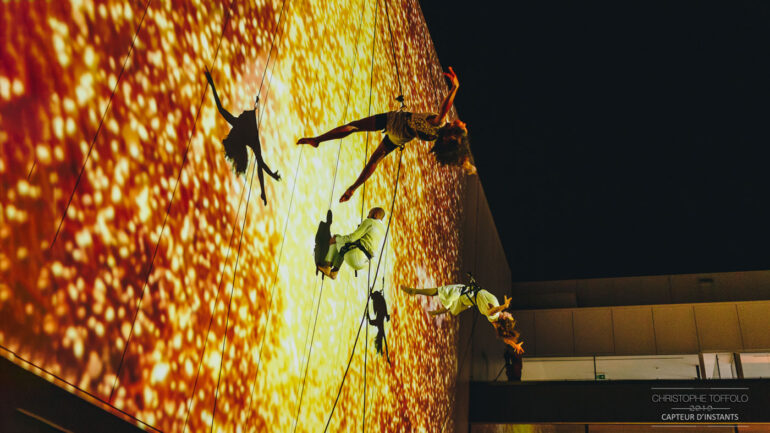
As part of the “Día de Muertos dans les Marolles” event, the “auQuai” Collective invites you to discover Homo-Luciola, a poetic performance born from a collaboration between artist Mira 眯腊, Yacin Sebti, Cie LaterrateraL and musician Stéphane Kozik.
Homo-Luciola brings together vertical dance, interactive audiovisual art and sound creation. Emerging from the encounter between the Fōz Machine, an interactive audiovisual device created by artist 眯腊 (mira), and the LaterrateraL company, the project transforms façades and architectural structures into living surfaces. Suspended in space, the performers’ bodies generate trails of light in real time, somewhere between photographic light painting and video mapping.
Structured as a dystopian tale, Homo-Luciola offers a free-ranging exploration of our relationship with images, from the earliest cave paintings to a future saturated with light and technology. Through the figure of a hybrid being, half-human, half-firefly, the performance draws on myths, flight and transformation to question our fascination with images, progress and the contemporary obsession with “ever faster, higher and further”.
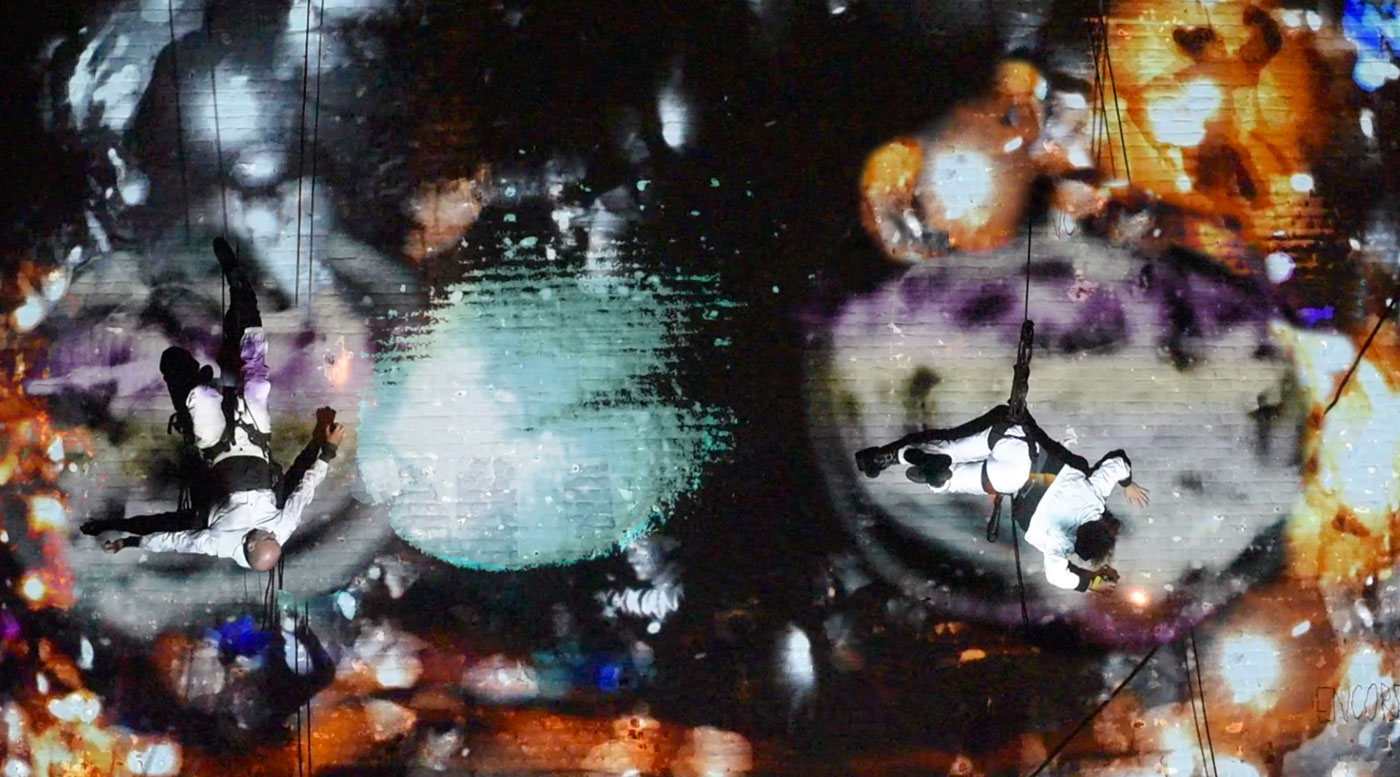
Fred Chemama (Fr/Be)

Photographer, videographer and multimedia artist Fred Chemama, also known as 眯腊 (mira), studied audiovisual production at ESRA Morocco and photography in France. He now lives and works between Belgium, France and his travels, which bring him into contact with other artists and cultural organisations across Europe and beyond.
During the final year of his studies, he travelled to Mexico to create a series of underwater portraits of fishermen in the state of Oaxaca, using a large-format field camera and a custom underwater housing. These portraits have since been submerged in illuminated tanks, where they have been gradually decomposing in water for several years. Over the years, he has also developed several long-exposure self-portrait projects.
Action, encounters and the self-reflexive exploration of processes used to capture images from reality, lie at the heart of his artistic practice. This has led him, among other things, to adopt an occasionally iconoclastic approach and create ephemeral in situ installations using discarded ink ribbons from souvenir photography booths.
Deliberate collective action and the exploration of different processes for producing images “drawn from reality”, were central to his early practice, already challenging the authority of the photographic image as a vehicle for information and transforming it into what he truly sees it as : a pretext for bringing people together through poetry.
Today, 眯腊 continues to experiment at the boundaries of photography, video and digital arts ; exploring the body, light, movement, situations and places through an approach rooted in physical action.
His latest interactive installation projects (“Cyclo-Kino”, the “Gestographe”, the “Fōz machine”…) combine and transcend disciplines and media through playful and intriguing devices.
Compagnie LaterrateraL (Be)
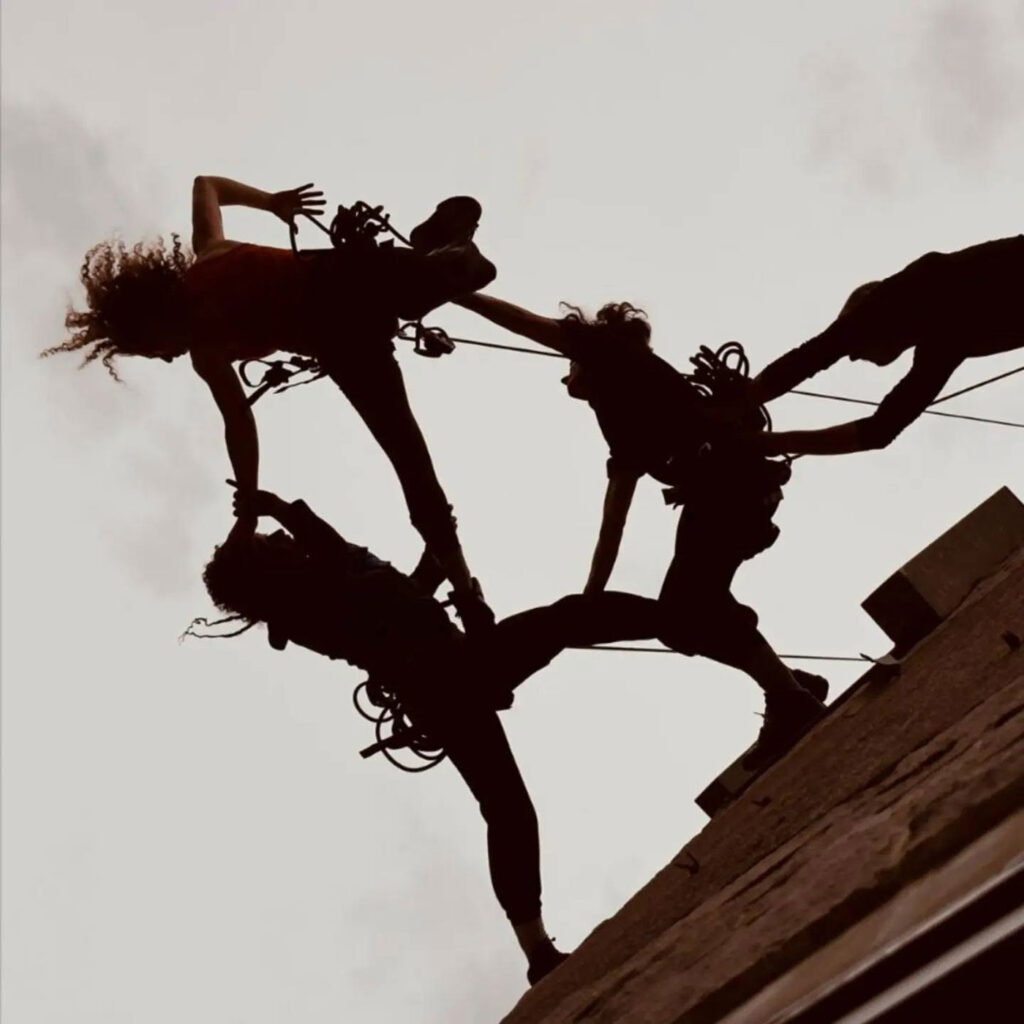 Founded in 2017, the LaterrateraL company creates vertical dance performances at the intersection of contemporary dance, circus and climbing. Its work draws on architecture and natural environments, turning façades, walls and structures into choreographic spaces where bodies move in new relationships with gravity, scale and perspective.
The company favours site-specific creations, developed in close dialogue with the places it inhabits and their surroundings. Depending on the project, dance may interact with live music, video or projection mapping, in performances that seek not so much to occupy a space as to reveal its lines, tensions and sensory possibilities.
Stephane Kozik (Be)
 An artist, sound artist and musician for some twenty years, Stéphane Kozik focuses primarily on audiovisual performances, sound installations, short films, etc. His multidisciplinary approach is sensitive, sensory and poetic, sometimes with a touch of humour. Through his works, he explores reality through the prism of sound, developing an audiovisual language that allows him to construct narratives and fictions in which music and sound take centre stage.
Stéphane is particularly interested in the way sound is treated in cinema : often relegated to the background, even though it plays a crucial role in evoking emotion, establishing atmosphere and shaping the viewer’s perception. Taking this observation as his starting point, he reverses this hierarchy and seeks to invent a “cinema for the ears”, a cinema of the senses, where image and narrative serve sound, rather than the other way around. His works thus become staged experiences designed to foreground listening, offering a new way of “staging sound”.
With this in mind, he continually develops new sound and musical devices, encouraging himself to explore unconventional ways of composing and producing music. Each new development opens up unexpected territory, giving rise to distinct, sometimes unforeseen sonic and visual worlds. Whether through performances, installations or videos, Stéphane Kozik experiments and plays with the close relationships between matter and sound, seeking to forge his own audiovisual language and, through it, offer a renewed interpretation of reality.
Yacine Sebti (Be)
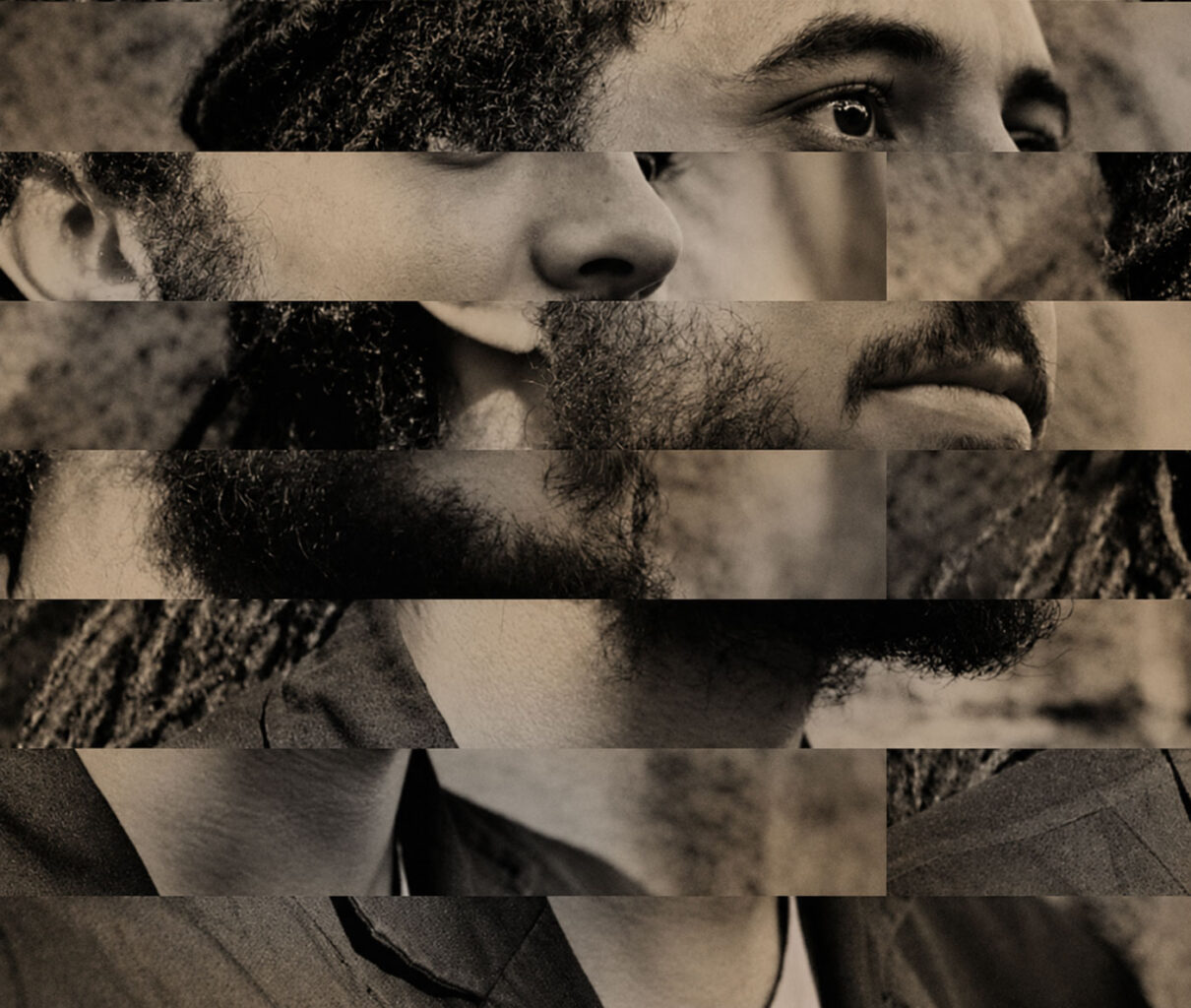 Brussels-based Belgian-Moroccan digital artist and developer Yacine Sebti has been creating interactive installations and performances since the early 2000s, exploring the relationships between the body, space, image, sound and technology. His practice combines artistic creation with real-time programming, particularly through audiovisual environments that respond to the movements of audiences or performers.
Creator of projects such as “Move in a Frame”, “Meet Somebody”, “Help Me ou Jump!”… He also collaborates with numerous artists as a developer and interactivity specialist. He has worked with Fred Chemama for many years : he is responsible for programming the “Fōz Machine”. For Homo-Luciola, he continues to develop the device, its electronics and its interactive features.
Fōz machine
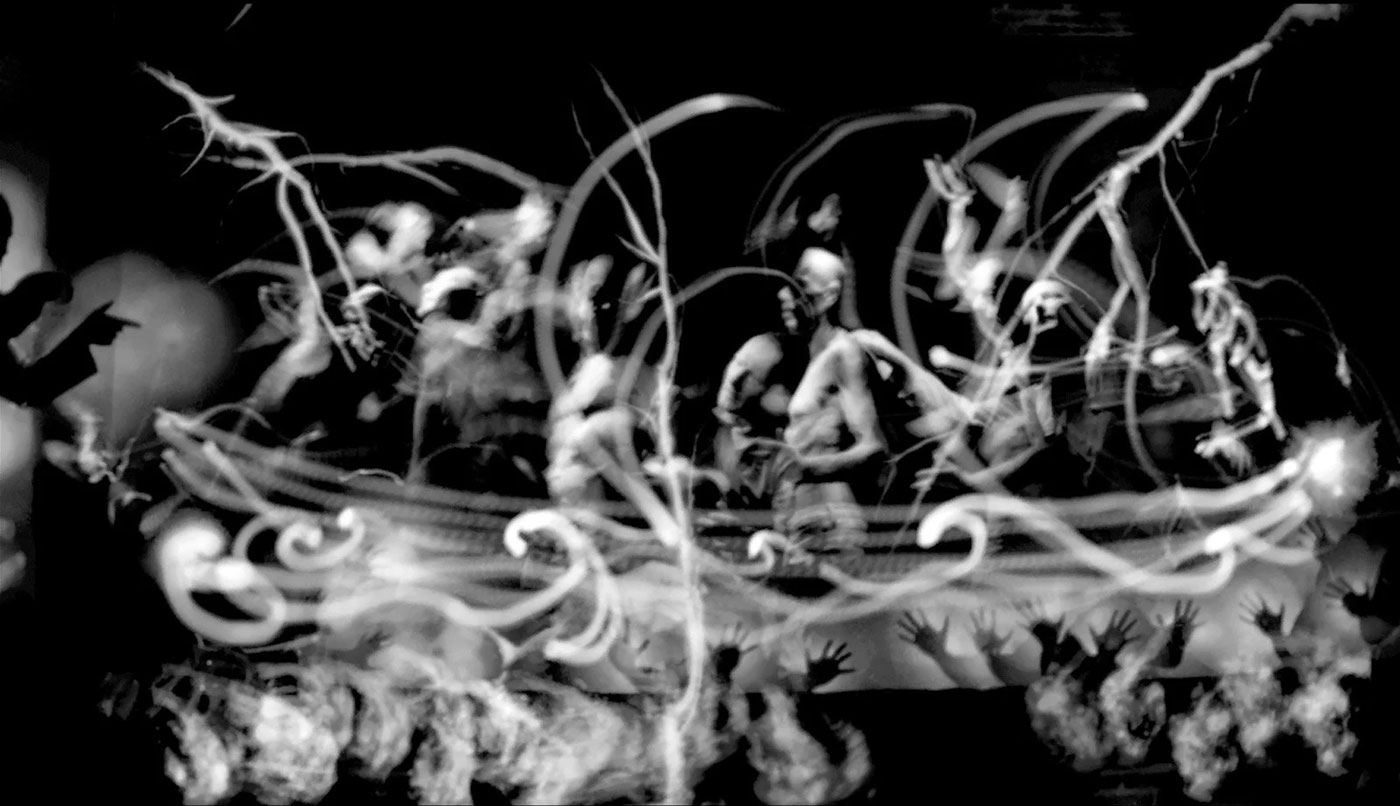
The “Fōz machine” is an interactive capture and projection device, created by artist Fred Chemama (眯腊 Mira), which can be adapted to all kinds of spaces.
A form of “mapping”, created by the user(s), in real time, exclusively through the use of incandescent or luminescent objects, brought along and / or available on site ( Flashlights, candles or similar objects ) .
Entering the “Fōz machine” means, above all, venturing into a dark space, with the possibility of creating a visual, luminous and ephemeral object; on, through and within, a given place, alone or with others. The technology remains hidden, revealing something otherwise invisible, a spatiotemporal trace of a passage, of a moment.
The “Fōz machine” creates a temporarily light-sensitive, active zone , filmed by an IR camera,where bodies, objects and the surrounding enclosure, if there is one, (the installation can also be set up outdoors ), instantly capture and reproduce the light that passes across them and what it reveals to the eye.
Día de Muertos dans les Marolles
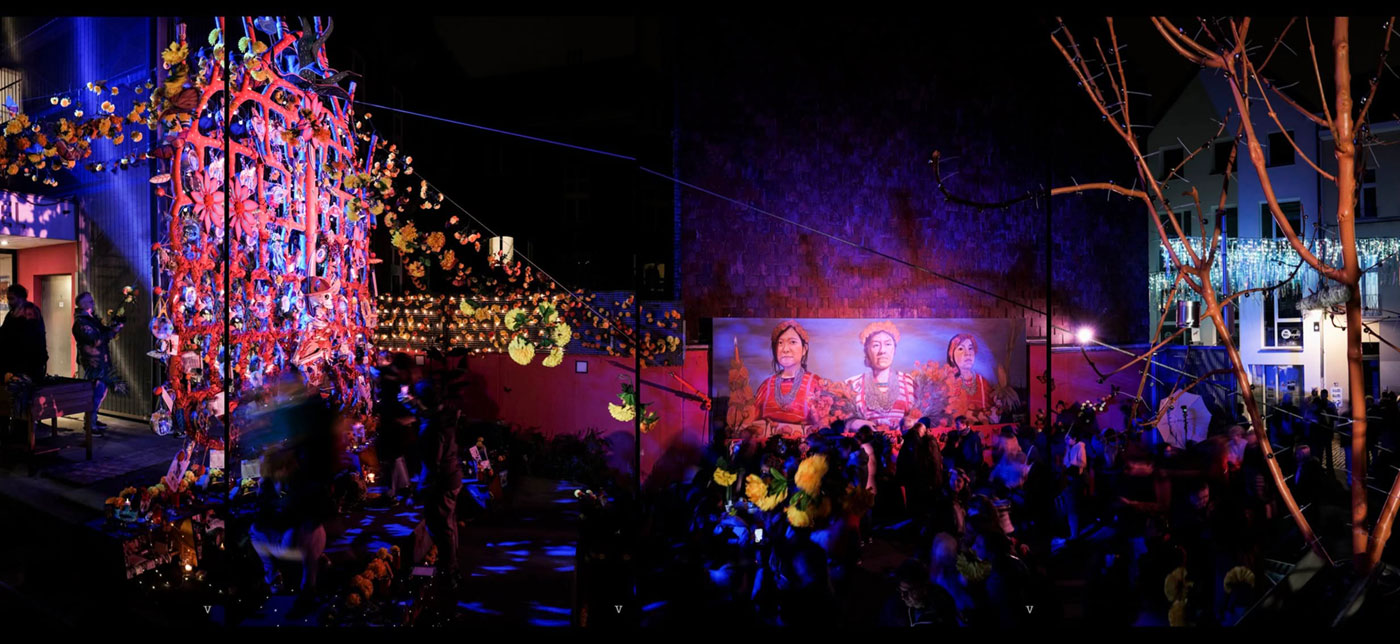
The “Día de Muertos dans les Marolles” festival has been running since 2018. It is an annual event founded by the TAS D’OS Collective around a universal gesture that contemporary societies have largely forgotten : honouring the dead. Rooted in the Mexican tradition, the Brussels edition is a joyful, hybrid festival, born from a collaboration between a collective of artists, neighbourhood residents and audiences from the wider community.
Through singing, making things, words and gestures, the event offers a space and time to remember, share memories, reinvent rituals and care for the dead… Whether alone, with family, among friends or with strangers, visitors find in Día De Muertos a contemporary setting in which to reflect on and tend to the memory of their dead. The event is non-denominational, open to everyone and rooted in a joyful, irreverent cultural exchange.
Día de Muertos is a village-style celebration, organised by and for local residents : rather than staging a show for a passive audience, we invite people to paint children’s faces, carry torches, leave offerings, share a hot chocolate, a glass of mezcal and a meal together. This village atmosphere takes shape through numerous collaborations with local neighbourhood organisations : Cyclup, the art et marges museum, “la maison de jeune des mercredis artistiques”
Information
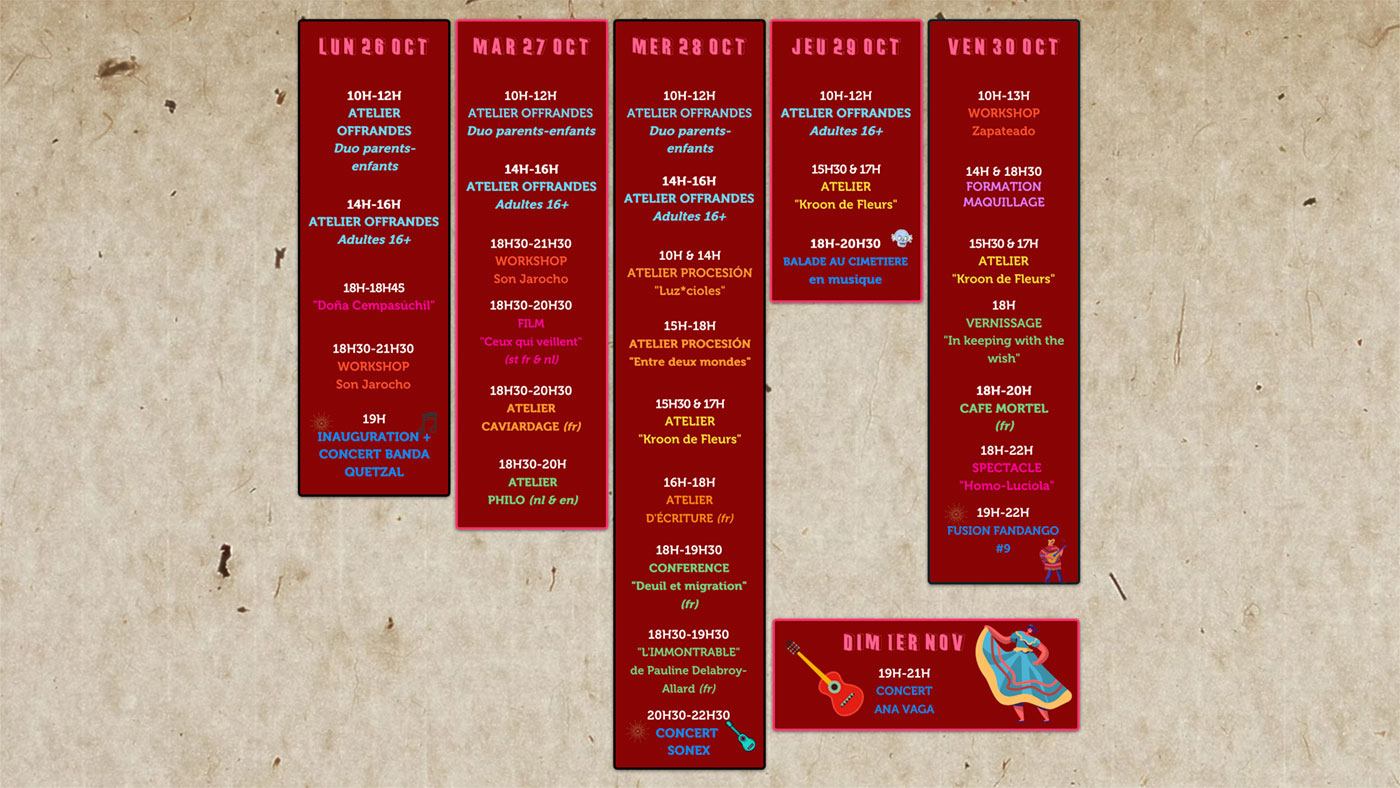
- 30.10.2026
- 18h–20h00 : doors open, light installation, workshops, soup and welcome
- 20h-20h30 : Homo-Luciola performance
- 21h-22h00 : audience interaction with the projection device
- L’Avant Senne – Rue des Vétérinaires 105, 1000 Brussels
- diademuertos.be – auquai.eu
Production
- Homo-Luciola has received support from Transcultures, the Fédération Wallonie-Bruxelles, le Chant des chevaux, le Manège Fonk, Eastern Belgium at Night
- The Fōz machine project has been supported by the Fédération Wallonie-Bruxelles (digital arts), Tanscultures and a wide range of partners since its inception
