


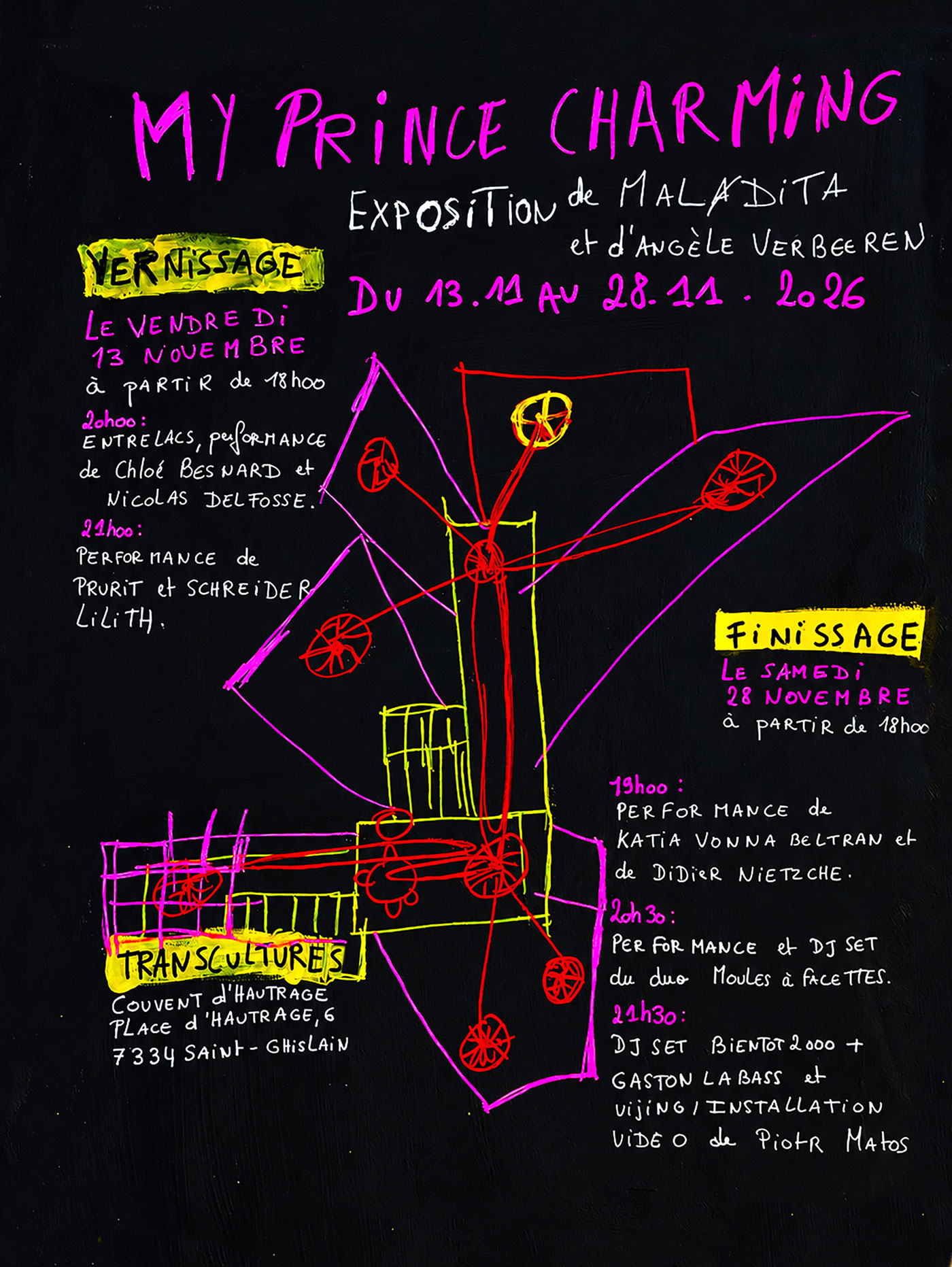
To mark the closing of the My Prince Charming exhibition by the Maladita collective and Angèle Verbeeren, the artists present an exhibition closing event at the Couvent d’Hautrage, bringing together audiovisual performances, sonic experimentation and DJ sets. A festive artistic gathering where electronic music, visual art and performance practices come together.
The programme features an audiovisual performance bringing together the electronic experimentation of Didié Nietzsche (A limb) and the live cinema of Katia Vonna Beltran (Life is a Lab); a performance and DJ set by feminist duo DJ Moules à facettes (Charlotte Cardon and Sarah Walker); and a musical and visual finale with Bientôt2000, joined by Gaston Labass and Piotr Matos‘s live video experimentation.
The evening will also be the last opportunity to see the exhibition My Prince Charming, on view at the Couvent d’Hautrage until Saturday 28 November 2026.
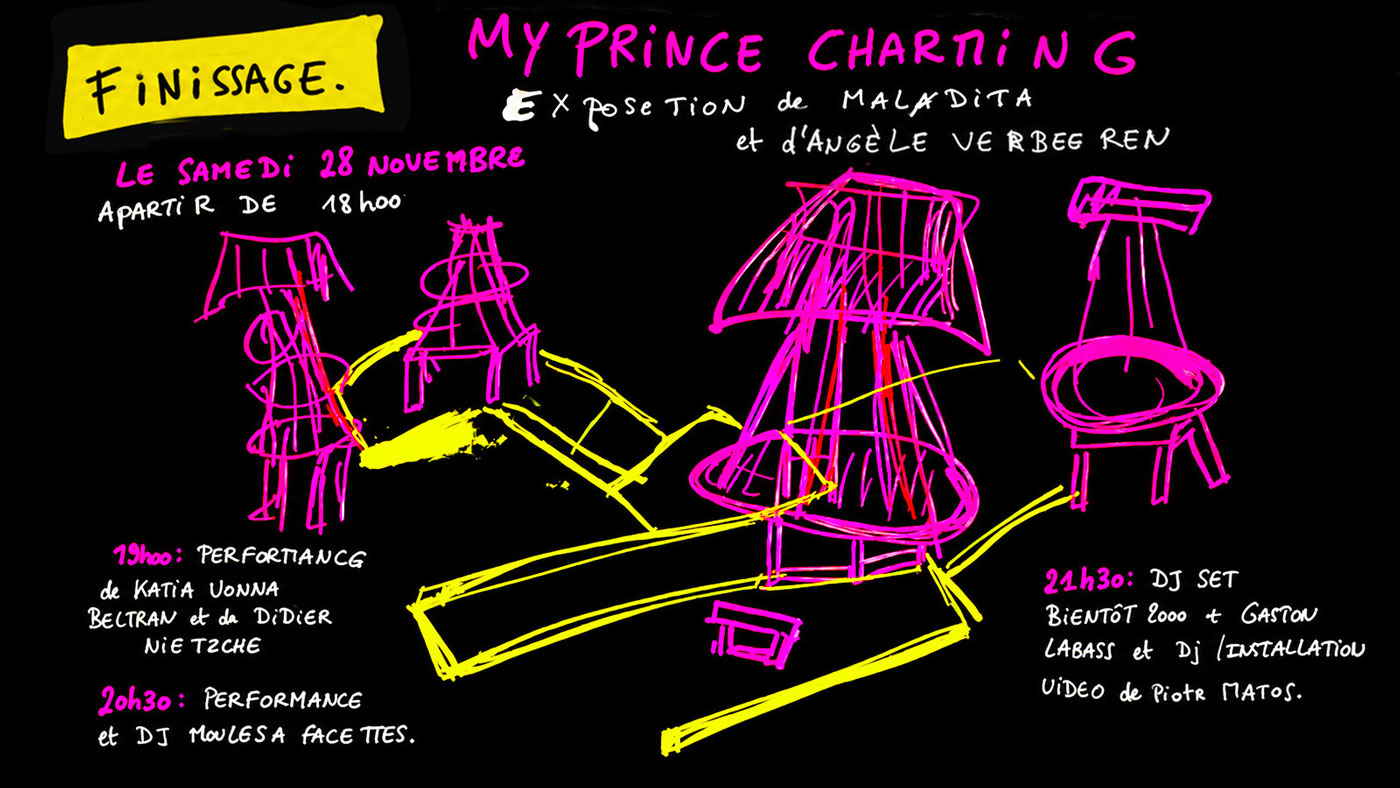
13 > 28.11.2026 - Exposition Maladita + Angéle Verbeeren
My Prince Charming
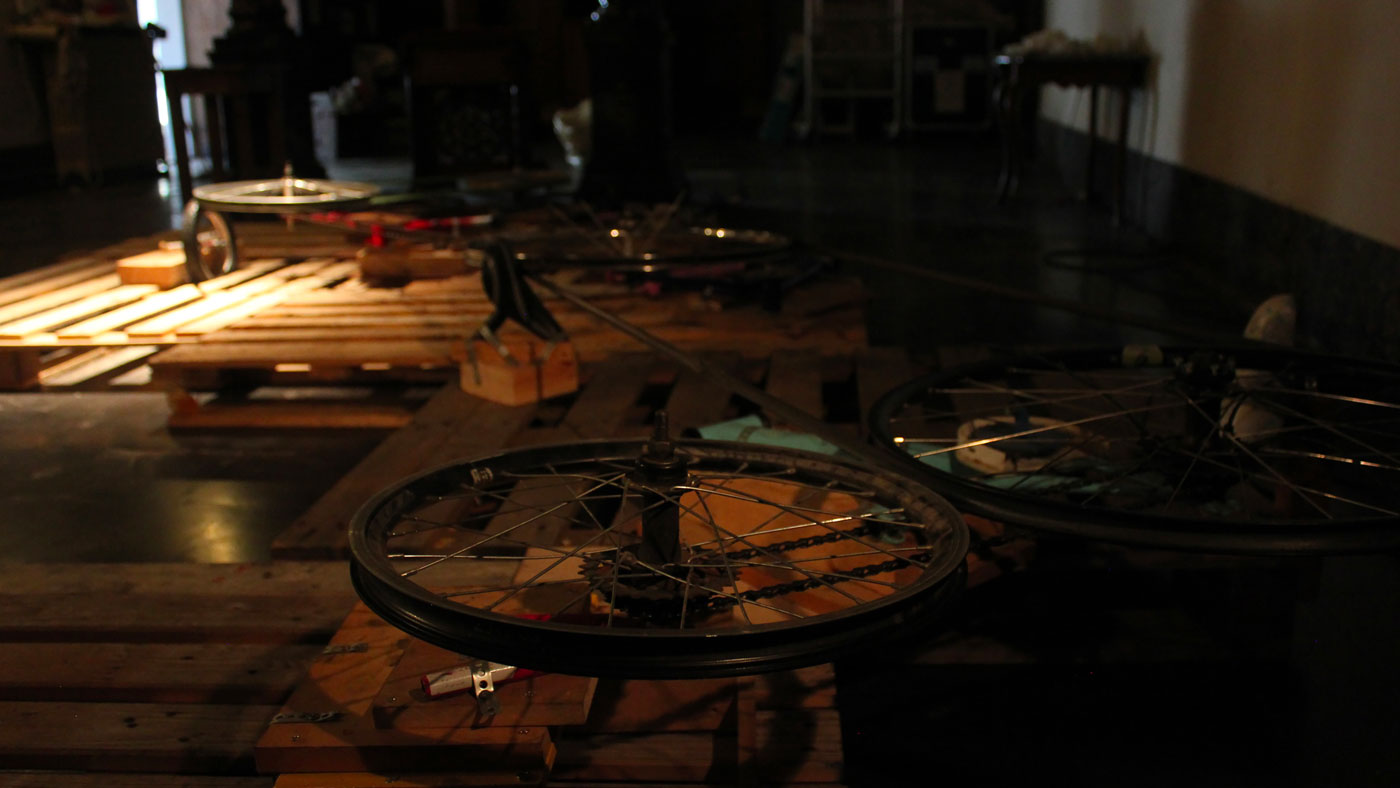
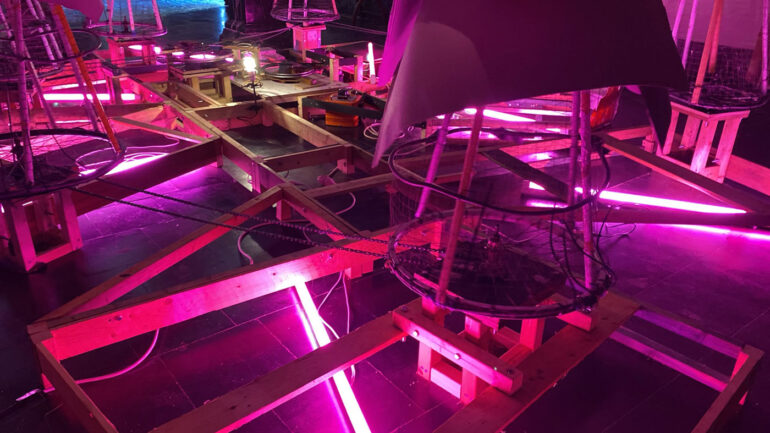
The installation features seven life-size papier-mâché figures of female saints, animated by a rotating mechanical system built from reclaimed materials. Presented in a cardboard theatre drawing on Baroque and Neoclassical aesthetics, they inhabit a setting of pink neon lights, a disco ball and disco songs sung by female voices. Among them are Saint Agatha and Saint Lucy, whose legends recount the violence endured by women who refused to submit to male demands, as well as Saint Aurelia and Saint Natalia, whose names echo those of the two artists.
The project also includes Le Lupanar, a vending-machine installation dispensing merchandise bearing the saints’ likenesses: candles, relics, clothing and other accessories. Drawing on practices of popular devotion and the trade in religious objects, this part of the installation explores the relationship between the sacred, commercial culture and consumption.
Developed in part during residencies at the Couvent d’Hautrage, *My Prince Charming* incorporates materials and textiles salvaged on site, as well as garments and fabric elements made in collaboration with local seamstresses. The project also involves research into the convent’s archives, intended to inform a publication bringing together saints’ stories, the memories of the nuns and the experience of artistic creation.
Maladita (Be)

Maladita is an artistic duo formed by Aurélie Bay and Nathalie Hannecart, visual artists and photographers based in Belgium. Having studied at the Fine Arts Academies of Charleroi and Namur respectively, they pursue a hybrid practice spanning photography, drawing, video, installation and artists’ publishing.
For more than six years, they have developed a collaborative body of work that is politically engaged, ironic and deeply rooted in a critical re-examination of femininity, religious narratives and popular myths. Their work draws on self-portraiture, humour and staging, as well as humble and symbolically charged materials.
They have exhibited in Belgium and internationally (France, Spain, Portugal, Brazil, Chile and elsewhere), and their work is held in several public collections, including the Musée de la Photographie in Charleroi and the Artothèque des Chiroux in Liège. In 2023, they received the “4 mains et plus si affinité” award from Galerie Vertige (Brussels), and in 2024 their book Pedro was shortlisted for the Prix du livre d’auteur at the Rencontres de la photographie d’Arles.
Aurélie Bay (Be)

Born in 1981, Aurélie Bay is a Belgian visual artist based in Brussels. Trained in photography, sculpture, drawing and video at the Fine Arts Academies of Charleroi and Molenbeek-Saint-Jean, she has developed a cross-disciplinary practice closely concerned with freedom, the body and trauma in its many forms.
Through her alter ego Maladita, she incisively examines the social construction of femininity, narratives of martyrdom, invisible lineages and structures of power. In installations combining humble materials, Baroque imagery, repurposed devotional objects and pop music, she stages hybrid, grotesque or sacred figures suspended between vulnerability and resistance.
Her work has been shown in numerous exhibitions in Belgium and internationally (France, Spain, Croatia, Canada, Portugal and elsewhere), as well as at art centres including Le Vecteur, Exit11 and La Châtaigneraie. She has also co-authored several small-press publications and fanzines, and was selected for the Prix de la Jeune Sculpture (2020) and the Prix du livre d’auteur at the Rencontres d’Arles (2024 selection).
Nathalie Hannecart (Be)

Nathalie Hannecart is a Belgian photographer who lives and works in Namur. After initially studying Romance philology at UCL (1998–2003), she turned to photography, graduating from the Fine Arts Academy of Namur (2010–2019).
Her work with analogue photography and alternative processes (cyanotypes and photograms) explores traces, palimpsests and the imprint of time on urban and industrial environments. Through her lens, she examines walls, seeking what emerges from beneath their surfaces and exploring the relationship between presence and absence.
In 2015, she co-founded Atelier 22 at the University of Namur, an analogue photography laboratory devoted to analogue practices and knowledge-sharing, which she continues to coordinate today.
She has held several solo exhibitions, including “Orfeo” in Brazil (2024) and “La nuit remue” at Le Delta in Namur (2021), and regularly takes part in group exhibitions in Belgium and internationally (Spain, Croatia, Chile, Portugal, Canada and elsewhere). Her work is held in several public collections, notably the Artothèque de Liège and Émulation (Liège).
She also pursues a collaborative practice within the Aspëkt collective and the Maladita duo, combining photography, drawing, video, installation and small-press publishing.
Angèle Verbeeren (Be)
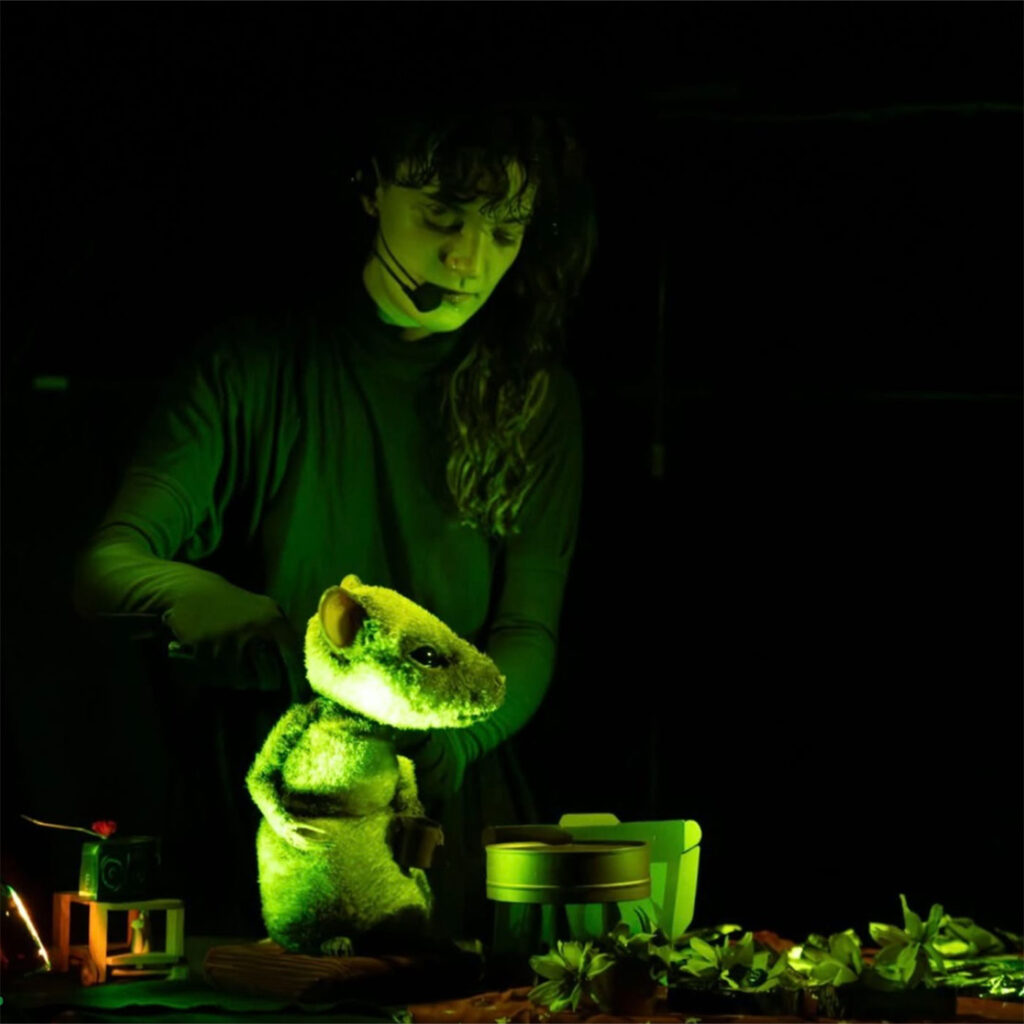
Born in 2000 and based in Mons, Angèle Verbeeren is a visual artist and puppeteer. Having studied sculpture, electronics and puppetry at Arts² (Mons, between 2021 and 2026), she has developed an artistic practice at the intersection of these disciplines, particularly exploring the relationships between electronics, installation and scenography.
Her work is informed by a critical, dissenting perspective that questions a society marked by violence and disconnected from lived realities. Adopting a playful approach that pushes against the conventions of the performing arts, she explores marginality through the codes and myths of childhood.
She explores ways of transforming materials through reuse and reclamation. Working outside established conventions of contemporary art, she seeks to make use of the resources closest to hand, from washing-machine motors to fabrics found in the spaces she inhabits.
19h00 - Performance A limb + Life is a lab
Didié Nietzsche (Be)
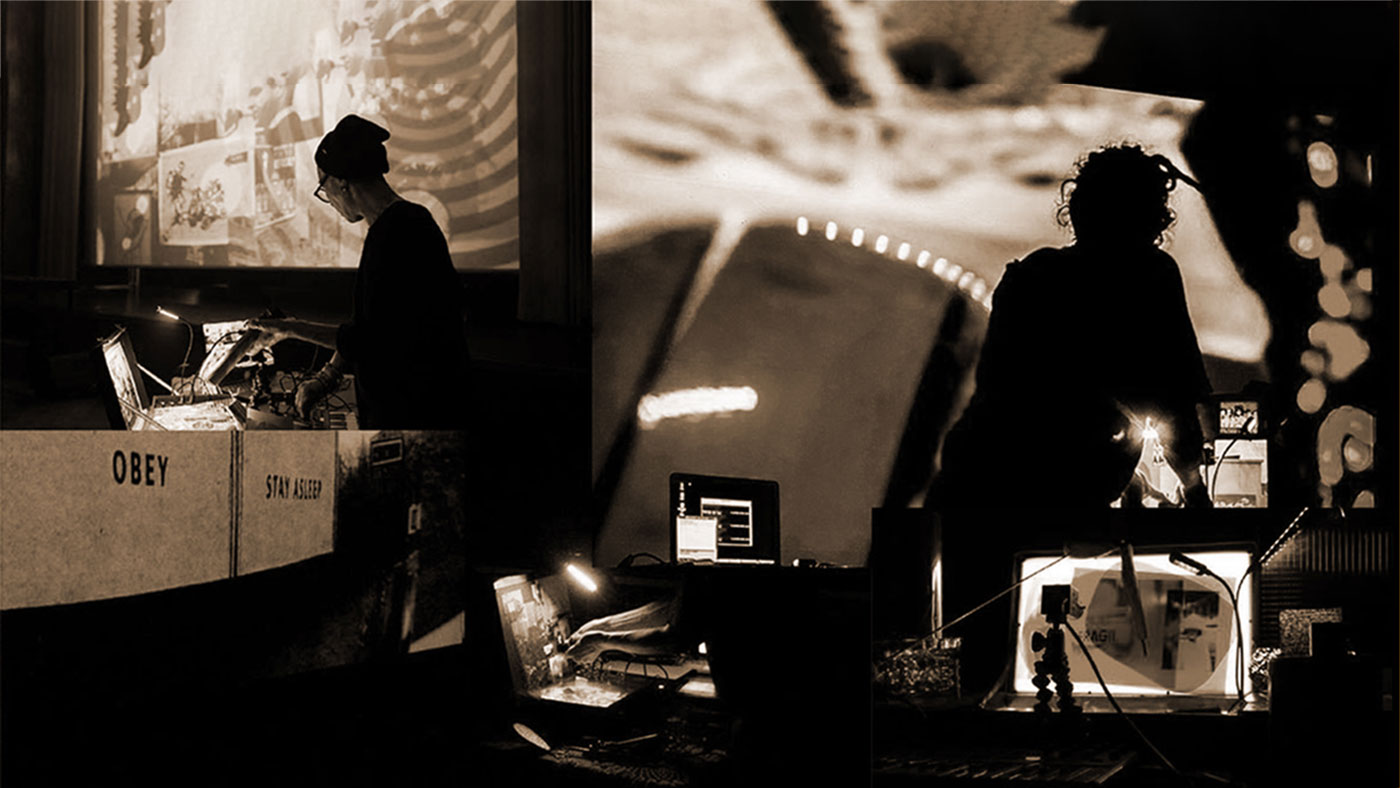
Bringing together Didié Nietzsche’s electronic experimentation (A limb) and Katia Vonna Beltran’s live cinema (Life is a Lab), this collaborative audiovisual performance creates a dialogue between sonic improvisation, poetic tinkering, moving images and low-tech technologies.
Conceived as a hybrid musical organism in a constant state of transformation, A limb blends ambient, drone and electronic rhythms with influences ranging from krautrock and jazz to funk and dub. This largely improvised sonic world meets the visual laboratory of Life is a Lab, where repurposed objects, recycled materials, archival footage and images captured in real time come to life before cameras and are instantly projected, creating an ever-shifting visual narrative.
At the intersection of musical performance, experimental cinema and live installation, the two artists explore the interplay of sound, image and gesture through a deliberately handmade and evolving setup. Informed by critical perspectives on ecology, nomadism, ecofeminism and the reclaiming of technology, the performance invites audiences to slow the flow of images, shift their perception of reality and imagine other ways of inhabiting the world.
Katia Vonna Beltran (Fr)
 A multidisciplinary and nomadic artist, Katia Vonna Beltran has spent more than twenty years developing a practice spanning photography, video, performance and live cinema. Her work is based on hybrid setups combining digital tools and low-tech technologies, which she uses to construct miniature worlds in real time from repurposed objects, recycled materials, archives and filmed images.
With a firmly DIY approach, her practice explores the relationships between artistic creation, ecology, technology and forms of resistance. Her performances favour simple, accessible means of creating spaces for storytelling and collective reflection, inviting audiences to reconsider their relationship with images, objects and contemporary issues.
Her work has been presented in a wide range of international contexts, notably in France, Germany, Finland, Morocco, Turkey and South Korea.
Didié Nietzsche (Be)
A Belgian musician and digital artist active since the early 1980s, Didié Nietzsche co-founded the experimental collective “Radio Prague” and has undertaken numerous projects and collaborations, including with 48 Cameras, Lamaφ, Neptunian Maximalism and Zaäar.
Under the name A Limb, he develops an open-ended electronic practice combining synthesisers, grooveboxes, digital processing and improvisation. Active in experimental music scenes and virtual environments, he regularly collaborates with sound artists, visual artists and performers, while maintaining a close artistic relationship with Transcultures and its Transonic label over many years.
20h30 - Performance - Moules à facettes
Charlotte Cardon & Sarah Walker (Fr)
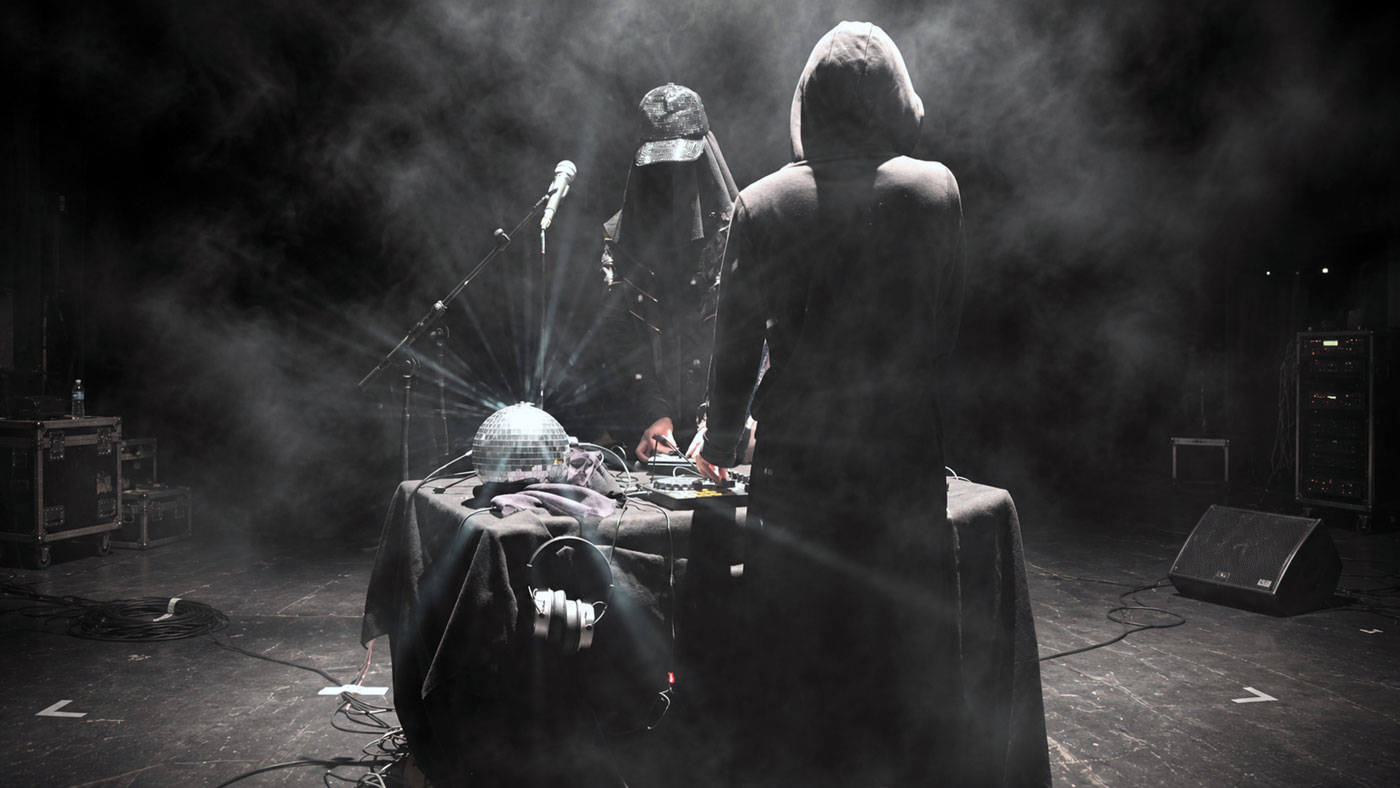
Originally formed in Lille as a trio with musician Timoté Grenier, DJ Moules à facettes has since evolved into a duo featuring Charlotte Cardon and Sarah Walker, two artists with backgrounds in theatre and circus. At the crossroads of DJ culture, electronic music and live performance, the project brings together autobiographical storytelling, writing, personal testimony and sonic experimentation using synthesisers and a Stylophone. Timoté Grenier’s compositions remain part of this constantly evolving musical world.
Rooted in a feminist approach, DJ Moules à facettes addresses issues including incest and sexual violence through an intimate narrative that examines mechanisms of silence, taboos, power relations and the challenges of speaking out and being heard. Music accompanies and shapes this narrative, bringing personal experiences into dialogue with other voices, testimonies and musical references.
Moving between sound performance, spoken word and moments of celebration, the duo reworks the traditional codes of the DJ set, turning it into a space for expression and exchange where the personal meets the collective and dance becomes a means of gathering and empowerment.
20h30 - DJ Set Bientôt2000
Bientôt2000 (Fr) - feat. Gaston Labass (Fr) & Piotr Matos (Be)
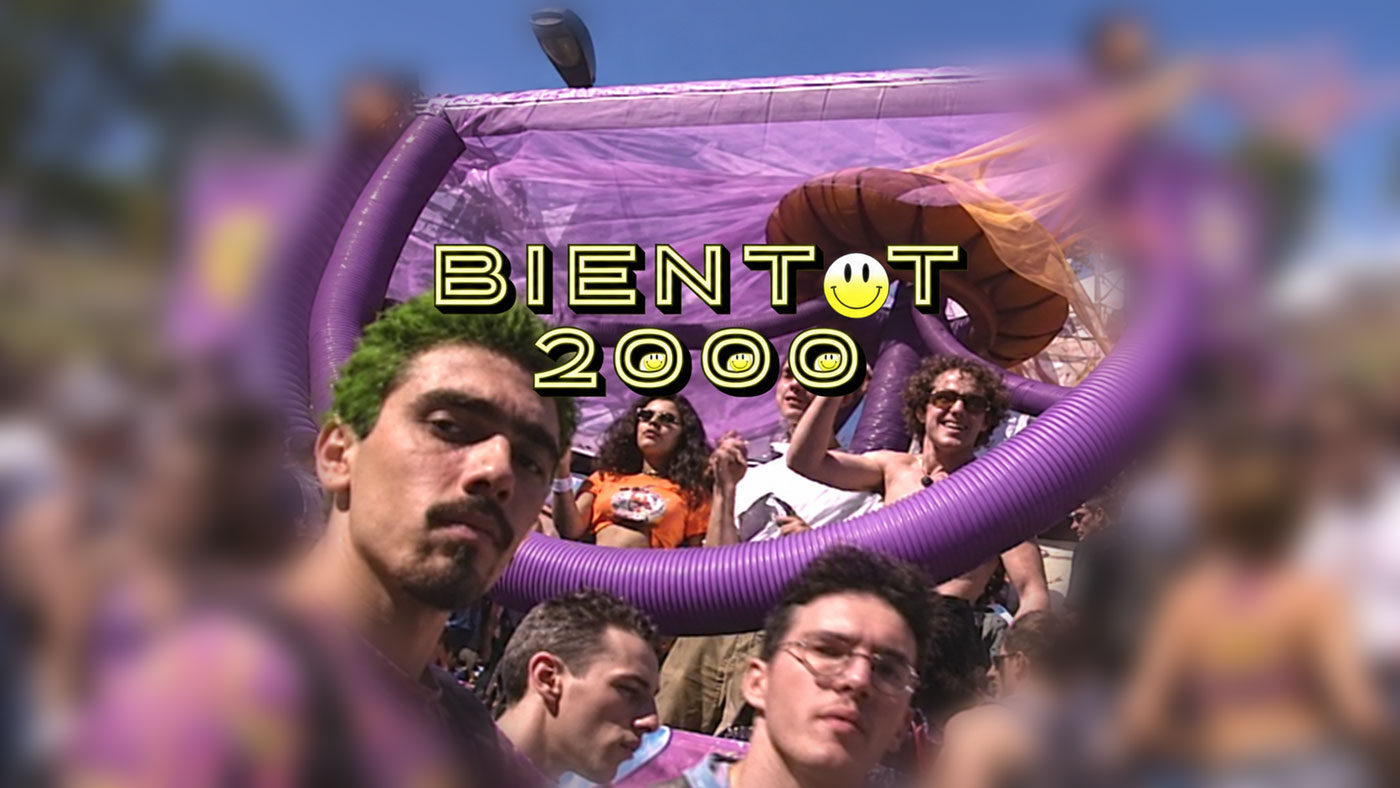
Bientôt2000 is a DJ duo revisiting the music and cultural imagination of the late 1990s, a time marked by anticipation of the year 2000 and the promise of a new millennium defined by progress and harmony. Through a selection of techno, house and dance tracks, the duo reconnects with the era’s celebratory energy and optimism.
For this performance, Bientôt2000 invites Gaston Labass and visual artist Piotr Matos to expand its musical world with funk and disco influences and live visual experimentation. Drawing on an exploration of the musical archives of both genres, Gaston Labass brings his rhythms and generous basslines to the collaboration, while Piotr Matos creates a world of moving images at the intersection of analogue and digital techniques.
Based in Liège, visual artist Piotr Matos develops an experimental practice encompassing drawing, printmaking, film and video. Working with Super 8 archives, found footage and her own recordings, she transforms and fragments visual material through both physical interventions on film stock and digital manipulation. Her performances combine projection, rear projection, graphic interventions and live manipulation, exploring persistence of vision and the emotional qualities of the image.
Bringing together club culture, musical memory and experimental cinema, this collaboration sets the electronic sounds of the late twentieth century alongside the legacies of funk and disco and a practice of visual deconstruction. An audiovisual performance that plays with time, technology and past and present imaginaries, moving between nostalgia for the future, collective energy, and sonic and visual experimentation.
Informations
- 28.11.2026 | Exhibition closing event – 18:00
- 14 > 28.11.2026 | Exhibition – 14 > 18:00
- Transcultures – Couvent d’Hautrage
- 6 Place d’Hautrage 7334 Saint-Ghislain
- Free admission
Production
- Maladita, Transcultures
- With the support of the Visual Arts Commission of the Fédération Wallonie-Bruxelles
